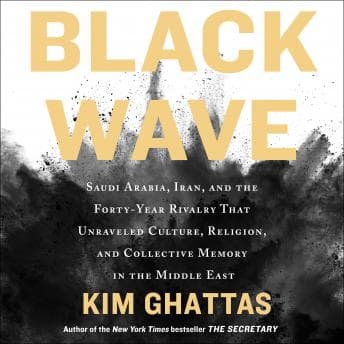

"The lights went out all over the Middle East." That's how Ghattas frames 1979, and I'm sitting in my truck outside a client's office in north Austin, engine off, coffee going cold, realizing I'm 45 minutes past my meeting time because I couldn't pull myself away from this book.
Let me cut to the chase: this is one of the most important audiobooks I've listened to in years. Not because it tells you something brand new — if you served in Iraq or Afghanistan, you felt the Saudi-Iran rivalry in your bones even if you couldn't articulate the full history. But because Ghattas connects four decades of dots in a way that made me genuinely angry I didn't have this context when I was deployed.
The Intel Brief I Needed Twenty Years Ago
Ghattas structures this around a simple but devastating thesis: 1979 was the year everything broke. The Iranian Revolution. The siege of the Grand Mosque in Mecca. The Soviet invasion of Afghanistan. Three events in a single year that sent Saudi Arabia and Iran into a competition to out-Islamize each other — and the rest of the region paid the price. She traces how Saudi money funded madrasas from Pakistan to Egypt while Iran exported revolution through proxies like Hezbollah in Lebanon.
What hit me hardest was how she tracks the human cost through individual lives. There's a Pakistani television anchor, Ghazala Minallah (I'm probably butchering the pronunciation, but Ghattas gets it right), who stood up to Zia ul-Haq's Islamization campaign. An Egyptian novelist, Nawal El Saadawi, jailed for her writing. The Saudi filmmaker Haifaa al-Mansour trying to make art in a country that didn't have movie theaters. These aren't just historical footnotes — they're people who watched their cultures get hollowed out in real time by a geopolitical chess match happening above their heads. That same gut punch of watching ordinary people ground up by forces they never consented to — I felt it reading Bury My Heart at Wounded Knee, different century and continent, same machinery.
I've seen this scenario play out in real life. When I was in Iraq in 2005, the sectarian violence felt like it came from nowhere. It didn't. Ghattas shows you exactly where it came from, how it was funded, who benefited. The through-line from the 1979 Iranian Revolution to the rise of ISIS isn't speculation — she maps it with the precision of a good intelligence analyst.
Two Narrators, One Clear Signal
The dual narration setup threw me for a second. Ghattas narrates portions herself, and Nan McNamara handles others. Ghattas brings something McNamara can't — the accent, the familiarity, the weight of someone who grew up in Beirut during the civil war reading about the destruction of Beirut during the civil war. When she's describing the assassination of Rafik Hariri or the murder of Jamal Khashoggi, there's a controlled anger in her voice that a hired narrator would have smoothed over.
McNamara is solid and professional, keeps the pacing steady through the denser historical sections. But the contrast is noticeable. Not in a bad way — more like the difference between reading a battle report and hearing it from someone who was there. At 1.25x, the pacing felt right. Sixteen-plus hours is a serious commitment, but the book earns every minute.
The author clearly did their homework. Twenty years of BBC and Financial Times reporting across the region, and it shows. She doesn't do the thing that drives me crazy in political books — she doesn't pick a side between Sunni and Shia, or between Saudi and Iranian grievances. She indicts both governments for weaponizing religion while making it clear that ordinary people in both countries were victims of their own leadership.
Where It Gets Uncomfortable
American policy takes some serious hits here, and they're deserved. The way the US propped up both Saudi Arabia and the Shah's Iran as "twin pillars" of regional strategy, then scrambled after 1979 and made everything worse — that's not anti-American bias, that's just the record. I spent 25 years serving this country and I can still acknowledge when we got it wrong. The section on how American support for the Afghan mujahideen created the conditions for al-Qaeda is stuff every American voter should understand.
This is where it lost me slightly — toward the last few hours, covering the Arab Spring and its aftermath, the pace feels rushed compared to the meticulous detail of the earlier sections. Four decades is a lot of ground, and the 2011-2018 period gets compressed. The Khashoggi murder closes the book but feels like it deserved more space.
Who Needs This in Their Ears
Worth your time? Here's the debrief: If you served in the Middle East and want to understand what you were actually standing in the middle of — this is essential. If you follow the news and wonder why everything from Lebanon to Yemen to Iraq seems permanently broken — this is the explanation. If you want something light for your beach vacation — look elsewhere.
Corporate clients I work with who have operations in the Gulf region? I'm recommending this to every one of them. Understanding the Saudi-Iran dynamic isn't optional if you're doing business there.
Ranger sat through the whole thing over about a week of walks and drives. He's a patient dog. Mission accomplished — this one's staying in the permanent collection.