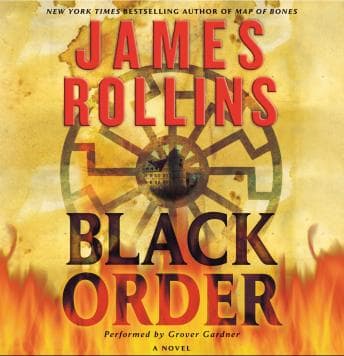

People keep telling me James Rollins is basically Dan Brown with better action sequences. I went in expecting that - popcorn thriller, thin characters, heavy on the Da Vinci Code vibes. And look, some of that's fair. But Black Order surprised me in ways I wasn't ready for, particularly when it came to Painter Crowe's storyline. That one hit me sideways.
I was up late installing a new security system at the house - one of those jobs where you're running cable through the attic and crawling under the house with a headlamp, and you need something in your ears to keep you from losing your mind. Fourteen hours and forty-nine minutes of Sigma Force operators doing their thing? Perfect company. Ranger parked himself at the bottom of the attic ladder like he was standing guard the whole time.
Nazi Science Meets Buddhist Monks (And It Somehow Works)
Let me cut to the chase: Rollins is juggling two major storylines here, and the ambition is impressive even when the execution gets wobbly. You've got Gray Pierce chasing down secrets from a bookstore fire in Copenhagen that leads to an abandoned Nazi lab inside a hollowed-out mountain in Poland. Then there's Painter Crowe - director of Sigma Force - deteriorating mentally in a Nepalese monastery where Buddhist monks have gone full cannibal. That sentence alone should tell you whether this is your kind of book.
The quantum physics angle threading through the plot is genuinely interesting. Rollins has a DVM degree and clearly spends serious time on his research before writing these things. The author did his homework on the science, even if he then takes that homework, straps it to a rocket, and fires it into the sun. The connections between quantum biology, the origin of life, and Nazi-era experiments feel grounded enough to keep you engaged - right up until the final act where things go pretty far off the rails. Some listeners bounced off that ending hard, and I get it. But I've read enough thrillers to know that sticking the landing is the hardest part, and Rollins at least swings big.
What kept me locked in was Painter Crowe's arc. Watching a competent leader lose his cognitive faculties - his mind literally breaking apart while he's trying to run an operation - that's uncomfortable in a way I didn't expect from this kind of book. I've seen guys come back from deployment with TBIs, watched sharp operators struggle with things that used to be automatic. Rollins isn't writing literary fiction here, but that particular thread carried real weight.
Gardner Carries the Load Solo
Grover Gardner is doing a one-man show across four continents, and the man earns his paycheck. He's not doing wild vocal gymnastics - no wildly distinct accents for every character - but he shifts his register enough that you always know who's talking. His pacing matches the action well. When Gray Pierce is moving through that Polish mountain laboratory, Gardner tightens up, gets clipped and urgent. Gardner shows that same steady hand with John Irving's sprawling cast in Cider House Rules. During the monastery scenes with Lisa Cummings, he pulls back, lets the dread build.
The real test for a narrator on a book like this is managing the exposition dumps without putting you to sleep. Rollins loves his info-heavy passages about quantum entanglement and Bell curves, and Gardner reads them with enough energy that they feel like briefings rather than lectures. I listen at 1.25x and never felt like I was missing anything, which tells you the pacing is right.
Where the Op Goes Sideways
This is where it lost me a couple times: the multiple storylines occasionally feel like they're fighting each other for oxygen rather than building toward something unified. You're locked into the Nepal monastery, tension ratcheting up, and then you're yanked back to Europe for a chase scene that doesn't carry the same stakes. It's a pick-up-and-put-down problem - not because the book is boring, but because your brain has to re-engage with a different thread every time Rollins switches lanes.
David Baldacci runs a similar multi-thread structure in Total Control, and it's a fair comparison point for how that juggling act can go.And the villains. The shadowy new order pulling strings from behind the curtain. They're functional, but I've seen this scenario play out in real life and in fiction enough to know when the bad guys are just chess pieces being moved around the board rather than people with genuine menace. The assassin tracking Lisa Cummings has moments of real threat, but the organization behind everything stays too abstract.
Third book in the Sigma Force series, and you can feel Rollins getting more confident with his characters. Gray Pierce has more depth here than in the previous entries, and the ensemble feels like an actual team rather than a collection of action figures.
Rollins keeps the team growing in later entries like Last Oracle.Debrief and Deployment Recommendation
Worth your time? Here's the debrief: Black Order is a solid military-adjacent thriller that punches above its weight class on the science side and occasionally stumbles on the structural side. If you're already into Sigma Force, this is where the series starts finding its legs. If you're new, you can jump in here without being lost, but you'll miss some character context.
Best for long drives or physical work where you need something propulsive enough to keep your brain engaged. Not a bedtime listen unless you want to be up until 0200. Ranger approved this one - though he did fall asleep during the quantum physics explanations. Can't blame him.