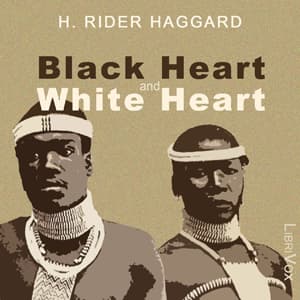

I came to this one expecting the usual Haggard adventure romp. King Solomon's Mines territory, you know? But Black Heart and White Heart is something different. Quieter. More intimate. And at just under two and a half hours, it's basically a long afternoon walk along the lakefront—which is exactly how I listened to it.
Victorian Romance With Actual Stakes
Haggard calls this "a Zulu Idyll" in his introduction, and that's... surprisingly accurate? This isn't a treasure hunt or a lost civilization epic. It's a love story. Two Zulu lovers trying to navigate courtship while the shadow of King Cetywayo's reign looms over everything. That tension between romance and external forces reminded me of Us, Again, though obviously in a wildly different setting. There's a witch with genuine prophetic power, an anti-hero who earns that title honestly, and enough mysticism threaded through the narrative that you're never quite sure what's fate and what's coincidence.
What struck me—and this is the English teacher talking—is how clearly Haggard writes. Victorian prose can be a slog (I've assigned enough of it to know), but this moves. The sentences have rhythm. There's a reason his work survived when so many of his contemporaries became footnotes.
Now, the elephant in the room. This is 1900-era colonial literature about Zulu people written by an Englishman. Some passages will make modern listeners wince. Haggard clearly respected Zulu culture—he spent time in South Africa, studied the people, and you can feel genuine admiration in how he depicts their traditions. But "respectful for his era" still means occasional moments of that patronizing Victorian gaze. If you've read any colonial-era African adventure fiction, you know the flavor. It's not malicious, but it's there.
Vira Denton Knows What This Story Needs
I couldn't find much about Vira Denton online, but based on this performance—she gets the assignment. This is a LibriVox recording, so we're not talking studio polish here. What we are talking about is someone who understands that Haggard's prose needs room to breathe. The pacing feels deliberate. The mystical elements get their weight.
Is it a dynamic, multi-voice theatrical production? No. But honestly? For a story this intimate, that might have been wrong. There's something appropriate about a single voice guiding you through what is essentially a folk tale elevated to literature. The witch's prophecies land. The romantic tension builds. The climactic moments hit.
(My students would absolutely zone out during the slower descriptive passages. I, however, was grading sophomore essays on The Great Gatsby and found the Zulu highlands considerably more engaging than another paper about the green light.)
The Pastoral Tradition, Relocated
Here's what I kept thinking about: Haggard wrote this as a "Zulu Idyll"—deliberately invoking the pastoral tradition. He's taking a form Europeans associated with idealized rural romance and applying it to African characters. For 1900, that's actually kind of radical? He's saying these lovers, this culture, this tragedy—it's worthy of the same literary treatment we give to Greek shepherds or English country maidens.
Does it fully succeed by modern standards? No. The framing is still colonial. But there's something in the attempt that feels genuine. The mysticism isn't exoticized for cheap thrills—it's integral to the plot and treated with real weight. The lovers aren't stereotypes. They have agency, make choices, face consequences.
This is why we still read the classics, even the problematic ones. Not because they got everything right, but because they show us how stories evolve. How empathy expands. How a Victorian adventure writer could reach toward something more human than his era typically allowed.
The Assignment
At 2 hours and 26 minutes, this is basically a long podcast episode. It's free (LibriVox), it's complete, and it's a fascinating artifact of a genre that shaped how the Western world imagined Africa for generations.
Best for: Fans of classic adventure lit who want something shorter and more romantic. Listeners interested in colonial-era African settings. Anyone teaching Victorian literature who needs a quick, accessible example of the period's contradictions.
Skip if: You need modern production values or can't tolerate any colonial-era perspective, however well-intentioned.
I listened at 1.0x because the prose deserves it. Haggard chose those words. The rhythm matters. My students would call me ancient for this take. They're not wrong, but neither am I.