Look, I'm going to say something that might get me in trouble with half my consulting clients: I'm tired of political books that treat the reader like a recruit who needs to be yelled into compliance. And for the first twenty minutes of Big Agenda, I thought Horowitz was going to do exactly that. He comes in hot - real hot - with the kind of scorched-earth rhetoric that makes you feel like you're sitting through a briefing where the intel officer already decided the conclusion before presenting the evidence.
But here's the thing. I kept listening.
The Briefing That Skips the Caveats
I was cleaning out the garage Saturday afternoon - Linda's been on me about it for weeks - and figured a four-hour political book was about the right length for sorting through fifteen years of accumulated junk. Ranger was sprawled across the concrete watching me like I was conducting a field exercise. Horowitz's central argument is essentially an operations order: identify the enemy, assess their tactics, develop a counter-strategy. That framework actually works pretty well if you're already sympathetic to his worldview. He traces the progressive left's institutional strategy with the kind of specificity I appreciate - naming organizations, connecting funding sources, showing how campus activism pipelines into policy positions. That part? The author clearly did their homework. Or at least, he's been doing this homework for decades through the Freedom Center.
But - and this is a significant but - the book reads like it was written in about three weeks right after the 2016 election, because it was. There's an urgency that sometimes crosses the line from passionate into sloppy. Horowitz will make a sharp tactical observation about how Democrats leveraged identity politics in specific congressional races, and then two minutes later he'll make a sweeping generalization that wouldn't survive a staff officer's red-team review. In the military, we called that "fighting the last war" - he's so focused on relitigating Obama-era battles that the forward-looking "plan" in the subtitle feels more like an afterthought than an actual strategy document.
Ian Patterson Does What He Can With a Manifesto
Patterson's narration is clean and competent. Straight read, no dramatics, which is actually the right call here. This isn't a book that needs theatrical delivery - it needs a steady, clear voice, and Patterson provides that. He sounds like a news anchor who leans slightly right but keeps it professional. He gave the same steady, no-frills read to Armageddon: How Trump Can Beat Hillary, and honestly that flat, professional delivery is the only thing that makes either book bearable. Nothing wrong with his performance, but nothing that elevates the material either. At just under four hours, the pacing works fine at 1.25x. I actually bumped it to 1.5x during a couple of the longer historical digressions where Horowitz rehashes ground he's covered in previous books. If you've read Radical Son or The Shadow Party, you'll recognize some recycled material here.
The audio production is bare bones - no music, no effects, just a guy reading a book. Which is fine. Political books don't need a soundtrack.
Where It Lost Me (And Where It Didn't)
This is where it lost me: Horowitz frames almost every political disagreement as an existential threat, which - having actually faced existential threats - gets exhausting. When everything is described in apocalyptic terms, nothing feels truly urgent. I've seen this scenario play out in real life, where a commander who treats every situation as maximum priority ends up with a team that can't distinguish between a real crisis and Tuesday.
Where it didn't lose me: his chapter-level analysis of how the left dominates institutional power structures - universities, media, nonprofits, government agencies - is genuinely useful if you're trying to understand the playing field. He's particularly sharp on how organizations like ACORN operated and how their model replicated across the progressive ecosystem. That kind of organizational analysis is my bread and butter in the consulting world, and Horowitz clearly understands how activist networks function.
For the slower, foundational version of the same argument, I keep a copy of Democracy in America Vol. II on the shelf.The four-hour runtime is both a strength and a weakness. Short enough that you won't lose interest, but it also means nothing gets explored with the depth it deserves. The "plan" portions feel like bullet points that needed another hundred pages of development.
Who Should Grab This (And Who Shouldn't)
If you're already in the Horowitz camp, this is a quick, energizing listen that'll confirm what you believe and give you some rhetorical ammunition. If you're looking for a balanced analysis of American political dynamics - keep driving, this isn't your exit. And if you're a moderate conservative who wants serious policy strategy rather than culture-war framing, you'll find the ratio here frustrating. About 60% diagnosis, 30% polemic, 10% actual plan.
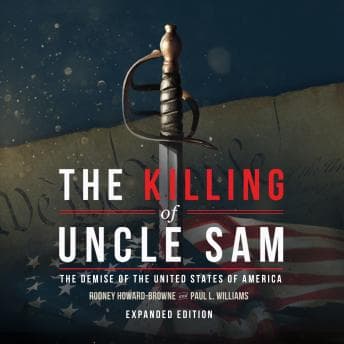
When I want that same brisk, combative tone from Patterson without the four-hour commitment, Killing of Uncle Sam scratches the itch.Mission Debrief
Worth your time? Here's the debrief: it's a fast, punchy political book from a guy who's been in the trenches of conservative activism for fifty years. The institutional analysis is genuinely useful. The rhetorical temperature runs too hot for my taste, and the "plan" is more of a sketch than a blueprint. At four hours, it's low commitment. I don't regret the listen - the garage is clean and I've got a sharper framework for a couple client briefings on political risk assessment. But I wouldn't spend a credit on it when you can probably stream it. Ranger slept through most of it, which tells you something.






![Steve Jobs [unabridged audiobook] audiobook cover](/_next/image?url=https%3A%2F%2Fcovers.audiobooks.com%2Fimages%2Fcovers%2Ffull%2F9788499923406.jpg&w=1920&q=75)