
Look, I'm going to be honest about something that embarrasses me as an English teacher with a graduate degree in literature: I had never read the Wisdom of Solomon. Twenty years teaching the Western canon, running a podcast about classic literature, and I'd somehow never cracked open one of the deuterocanonical books that shaped centuries of Christian theology and Western philosophy. My wife Denise would call this a blind spot. I'd call it a chasm.
So there I was, Sunday morning, coffee going cold on the counter while Denise was at her sister's, and I figured - seventy-seven minutes. That's shorter than a faculty meeting about parking lot protocols. Let me finally sit with this text.
The Book Your Bible Left Out (Maybe)
Here's what irritates me about the Protestant tradition I grew up in: we just... dropped these books. The Wisdom of Solomon sits in this strange theological no-man's-land - canonical for Orthodox and Catholic Christians, apocryphal for Protestants, and completely unknown to most of my students who couldn't tell you the difference between Ecclesiastes and Ephesians anyway. But this text is doing something genuinely fascinating. It's a Jewish wisdom text, probably written in Greek in Alexandria around the first century BCE, and it reads like someone trying to bridge Hebrew theology with Greek philosophy. Solomon - or whoever is writing in Solomon's voice - is essentially arguing that wisdom isn't just practical shrewdness (that's Proverbs territory) but a cosmic force, almost a person, emanating from God.
And in the KJV translation? The language hits differently than modern renderings. There's a passage in chapter 7 where wisdom is described as "the brightness of the everlasting light, the unspotted mirror of the power of God, and the image of his goodness." That triple construction - brightness, mirror, image - each one pulling you closer to something you can almost see but not quite touch. This reminds me of what Hemingway said about prose architecture, except this predates Hemingway by about two thousand years and honestly does it better.
The middle chapters pivot hard into a polemic against idolatry that's almost satirical in its specificity - the woodcutter who carves an idol from leftover lumber, praying to a dead thing for life, asking something with no legs to help him on a journey. There's a dark comedy in it that I don't think gets enough attention. My students would hate this. I love it.
A Volunteer's Courage and Its Limits
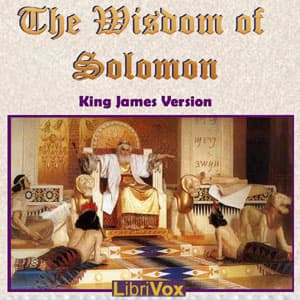
Let's talk about the elephant in the room. This is a LibriVox recording, which means it's free, which means it's volunteer-produced, which means you calibrate your expectations accordingly. The narrator - credited simply as "A LibriVox Volunteer" - actually left a note apologizing for errors and stumblings. And yes, there are moments where the reader trips over the KJV's particular syntax, those long subordinate clauses that pile up like theological Russian nesting dolls. You can hear the breath catch in the wrong place occasionally, a word slightly mangled before being recovered.
But here's what I'll say in this narrator's defense: there's a sincerity to the delivery that you don't always get from polished studio recordings. When the text reaches its poetic heights - and there are genuine heights here - the reader leans into them with real conviction. The prose deserves to be savored, and this reader clearly believes that. It's not a professional performance, and I wouldn't pretend otherwise. But it's an earnest one, and for a devotional or contemplative listen, earnestness counts for something.
The production is bare - no music, no chapter transitions, no atmospheric layering. Just one voice and the text. For seventy-seven minutes of ancient wisdom literature, that's probably the right call.
Who Needs This (And Who Doesn't)
If you're Orthodox or Catholic and already encounter the Wisdom of Solomon in liturgical settings, this is a convenient way to hear the full text in the KJV's particular music. If you're a literature person like me who's been skating past the deuterocanonical books your whole career, this is a short, painless corrective. If you want the audiobook equivalent of a meditation - something to sit with quietly on a Sunday morning - the brevity and simplicity work in its favor.
But if you want polished narration? If stumbles pull you out of a text? If you need production value to stay engaged? This probably isn't your version. There are other recordings out there. This one is free, it's honest, and it gets the job done with humility.
The Margin Note I'd Leave My Students
I ended up listening twice. Once on that Sunday morning. Once Monday night while grading a stack of essays about The Great Gatsby that all seemed to think the green light was about money. (It's about money AND the impossibility of recovering the past, Jayden. We talked about this.) The Wisdom of Solomon's meditation on mortality and the illusion of permanence hit different while reading seventeen-year-olds' attempts to understand Fitzgerald's obsession with the same themes. Some questions really are eternal. The narrator understands that pause is punctuation - even when stumbling through it. The mortality question especially - I kept thinking about how Paulo Coelho circles the same territory in Veronika Decides to Die, though ancient Alexandrian wisdom literature handles the weight of it with considerably more grace than he does. Worth pausing the faculty meeting for, if only because it's more honest than most things said in that room.