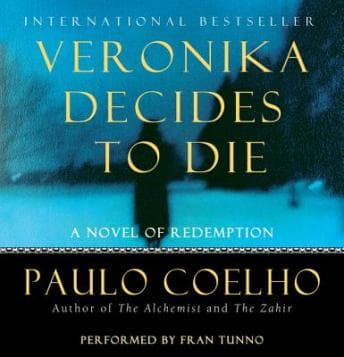

"On the whole, people don't want to be cured. They find a certain comfort in their madness."
That line hit me somewhere around hour two, during a faculty meeting about standardized testing protocols. Principal Martinez was explaining something about benchmark assessments. I was in a mental hospital in Slovenia with a woman who'd just tried to end her life. The irony of listening to a book about institutional definitions of sanity while sitting in a room where we were earnestly debating whether a seventeen-year-old's soul could be measured by a scantron—well, Paulo Coelho would've appreciated that.
What Hemingway Would've Cut, Coelho Keeps
This is not The Alchemist. If you came looking for that book's clean parable structure, you'll find something messier here. The narrative jumps between Veronika's deteriorating heart and the other patients at Villete—Mari, the lawyer who had panic attacks, Zedka with her depression, Eduard the schizophrenic painter. Coelho doesn't just tell you their stories; he interrupts Veronika's story to tell you theirs. Some listeners find this lazy. I found it honest.
Because here's what the author is really saying: madness isn't individual. It's relational. Veronika's suicide attempt only makes sense when you see it against the backdrop of everyone else's quiet surrenders to what society calls "normal." The jumping perspective isn't a flaw—it's the point. Though I'll admit, around hour three, I did wish Coelho would stay with Veronika a bit longer before dragging me to another philosophical aside about Bitter Venom and Vitriol.
At five and a half hours, this is a compact listen. Coelho doesn't waste words, but he does repeat ideas. The message that we're all dying and should live accordingly gets hammered home with the subtlety of a sophomore's thesis statement. My students would roll their eyes. They'd be right to. But they'd also miss the genuine urgency underneath the repetition—Coelho wrote this after his own institutionalization, and you can feel him working something out on the page.
Fran Tunno Finds the Irony in Despair
Tunno's narration has this quality I can only describe as "charmingly ironic"—she reads Veronika's bleakest thoughts with a kind of wry detachment that somehow makes them more devastating, not less. There's a moment early on where Veronika is calculating whether the sleeping pills will work, and Tunno delivers it with such clinical calm that you realize: this is how depression actually sounds. Not dramatic. Just tired.
She handles the philosophical passages without making them sound like a TED talk, which is harder than it sounds. When Coelho goes on about Slovenian history or the nature of consciousness, Tunno keeps the rhythm conversational. I listened at 1.0x—the author chose those words, and Tunno chose those pauses. Both choices deserve respect.
No accent work to speak of, no full cast, no sound effects. Just one voice carrying you through a woman's last days. It's intimate in a way that serves the material.
The Ending Problem (Let's Be Honest)
I have to address the elephant in the room: the ending. Without spoiling it, I'll say that Coelho makes a choice that some listeners find redemptive and others find cheap. After four hours of genuine darkness—of really sitting with the question of why anyone would choose to die when they have everything—the resolution feels... convenient.
Denise asked me about it on our lakefront walk. "Was it good?" And I said, "It was good until it decided to be hopeful." Which isn't fair, exactly. Coelho earned his hope. He lived through his own institutionalization. But the literary part of my brain wanted him to trust the ambiguity more. The human part of me was grateful he didn't.
Who This Is (and Isn't) For
Skip this if you need plot momentum or can't stand philosophical tangents—my students would hate it, and they'd have a point. But if you loved The Bell Jar's unflinching interiority and wanted something with more explicit philosophy, this is its spiritual successor. The Great Gatsby does something similar—burying its philosophy under all that glitter and champagne. If you're looking for Coelho's mystical optimism, it's here, but buried under something darker than The Alchemist ever attempted.
This book asks you to focus. The philosophical content doesn't work as background noise—you'll lose the thread between Veronika's physical decline and her spiritual awakening. I'd recommend dedicated listening, maybe during a solo walk or late at night when you're already in a reflective mood.
Class Dismissed
Not perfect—the pacing is uneven, the ending is too neat, and Coelho occasionally mistakes profundity for wisdom. But it takes seriously a question most books won't touch: what if the mad ones are the only sane people left?
Worth your time. Worth your attention. Worth the awkward moment when Principal Martinez asked if I had any questions about the new assessment rubric and I had to pretend I'd heard a single word.