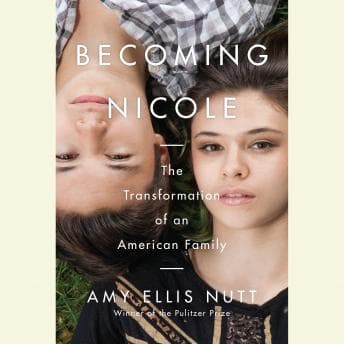

This book broke me a little, and I mean that as the highest compliment.
I was making chana masala — my mother's recipe, the one that takes forever because you have to bloom the spices just right — when the section about Wayne Maines hit me so hard I forgot to stir. The onions burned. I didn't care. Because here's this conservative, ex-military father from Maine who adopted twin boys and had every expectation of raising them into a very particular kind of American manhood, and then one of his children says, essentially: I am not who you think I am. And watching Wayne's psychology shift across years — from confusion to denial to fierce, protective love — is a fascinating case study in how identity isn't just something we build for ourselves. It's something the people around us have to rebuild too.
The Psychology of a Family Rewriting Its Own Story
What makes this book genuinely remarkable from a psychological perspective is its treatment of the entire family system, not just Nicole. Amy Ellis Nutt understands that when one family member transitions, every relationship in that constellation has to renegotiate its terms. Jonas, Nicole's identical twin, is maybe the most psychologically interesting figure here. The way identity fractures and reforms within a single family unit reminded me of what David Mitchell does so quietly in Black Swan Green — that novel is essentially a case study in how a boy's sense of self gets constructed and demolished by everyone around him, piece by piece. Think about that: you share literally the same DNA as someone, and yet your experience of gender is fundamentally different. The research actually shows that identical twin studies have been crucial to understanding the biological basis of gender identity, and Nutt weaves this science in without it ever feeling like a textbook detour.
But it's the early childhood scenes that got me. Wyatt (before becoming Nicole) insisting on being female as a toddler — not performing femininity, not mimicking, but insisting with the kind of certainty that most adults can't muster about anything. I found myself asking: why does our culture demand that a three-year-old justify an identity that the rest of us get to take for granted? That question sits underneath this entire book and it never goes away.
When the Law Becomes the Antagonist
The court case — Nicole's fight for the right to use the girls' bathroom at her school — is where the book shifts from intimate family portrait to something bigger and angrier. And Nutt handles it without melodrama, which actually makes it more devastating. The legal proceedings expose how institutions that are supposed to protect children can become the very mechanism of their harm. One student's grandfather, a conservative community member, pressured the school to bar Nicole from the girls' restroom. That detail stuck with me. An adult man, threatened by the existence of a child. Psychologically, this doesn't track as rational fear — it tracks as identity threat, the kind where someone else's truth feels like an attack on your own worldview.
The Maines family's social isolation during this period — friends pulling away, community turning hostile — is textbook minority stress. That slow erosion of belonging inside a tight-knit community is something Paris Library maps with real precision too — the way ordinary people quietly withdraw from those who suddenly make their world feel complicated. The research shows that it's not just the big events that damage mental health, it's the accumulation of small rejections. Nutt captures this without ever spelling it out in clinical language. She just shows you what it looks like when a family eats dinner knowing their neighbors don't want them there.
Nutt Reading Her Own Work
So here's the thing about author-narrated nonfiction: it's a gamble. Sometimes you get someone who knows their material but can't perform it. Nutt falls somewhere interesting — she's not a voice actor, and you'll notice that. The delivery is measured, journalist-steady, which means the emotional peaks don't always land with the force the material deserves. But there's an intimacy to hearing the person who spent four years reporting this story actually tell it to you. You can hear where her voice catches slightly on certain details, where the pacing slows because she's choosing her words like they matter. Because they do. It won't win narrator-of-the-year awards, but it feels honest. And for this particular book, honesty matters more than theatrical range.
At 8 hours and 45 minutes, it's a focused listen. No padding, no unnecessary detours into political commentary that would date it. Nutt trusts the family's story to carry the argument.
Who Needs This and Who Doesn't
If you want to understand how identity actually works — not the Twitter version, not the talking-points version, but the messy, complicated, embodied reality of it — listen to this. If you're a parent, especially. If you study psychology, definitely. If you think you already understand what it means to be transgender and don't need another book about it — honestly, maybe especially then. My therapist would have thoughts about anyone who thinks they've got human identity fully figured out.
Skip it if you want something fast or light. This requires your attention.
The Case File Stays Open
I finished the chana masala eventually. Sat down with my bowl and just thought about Wayne Maines for a while — this man who had to dismantle his entire framework of what fatherhood meant and build something better. The protagonist exhibits classic cognitive dissonance resolution, but that clinical framing doesn't capture what it actually feels like to watch someone choose love over comfort, over and over, until it stops being a choice and starts being who they are. That's the real transformation here. Not just Nicole's. Everyone's.