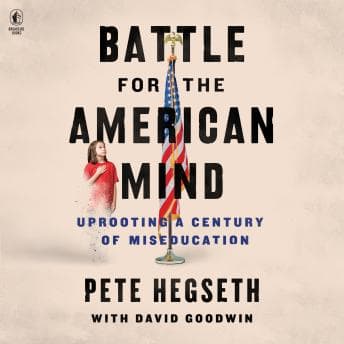

Let me cut to the chase: I went into this expecting a polemic with some educational theory sprinkled on top. What I got was closer to an operational brief—a surprisingly systematic breakdown of how American education got from point A to point B, with a clear extraction plan.
Ranger and I finished this one during a week of long drives between client sites. The dog's a good sounding board. He didn't seem to mind Hegseth and Goodwin's dual narration, and neither did I.
The Intel Assessment
Here's what caught my attention: the authors clearly did their homework on the historical timeline. They trace the progressive education movement back to Horace Mann and John Dewey with the kind of methodical sourcing I'd expect from an S-2 shop. Whether you agree with their conclusions or not, they're not just throwing grenades—they're building a case.
Hegseth brings the Fox News energy you'd expect, but Goodwin—the classical educator—grounds it. The alternating narration actually works here. You get Hegseth's combat veteran intensity (and yeah, I respect the Bronze Stars) paired with Goodwin's more measured academic delivery. It's like having a fire team where one guy's the breacher and the other's running comms.
The core argument? That progressive educators didn't just change what kids learn—they changed why kids learn. They swapped out what the authors call "paideia" (a Greek concept of forming the whole person toward virtue) for something more... utilitarian. More controllable. It's a conspiracy theory to some folks, sure. But I've seen enough institutional rot in my 25 years to know that slow, deliberate capture of systems isn't exactly unprecedented.
Where It Loses the Objective
Now look—I'm not going to pretend this is balanced journalism. It isn't trying to be. The authors have a clear mission: convince parents that classical Christian education is the answer. And they push that hard. Maybe too hard for some listeners.
The book gets repetitive in the middle sections. Around hour five, I found myself thinking "Roger that, I get it, progressive education bad" while merging onto I-35. They could've tightened this up by about 90 minutes without losing the message. Ranger actually fell asleep during one of the more redundant stretches—and that dog's heard me listen to some dry material.
Also, if you're not already sympathetic to conservative Christianity, parts of this will feel like you're being recruited rather than informed. That's not necessarily a flaw—they're upfront about their worldview—but know what you're signing up for. I appreciated that same kind of clarity in Story of Joan of Arc—another book unafraid to take a stand on what virtue looks like.
The Tactical Value
What saves this from being just another culture war screed is the practical guidance in the final sections. They don't just complain—they offer an actual alternative. The breakdown of classical Christian education principles, the discussion of how to evaluate schools, the framework for what education should accomplish... that's useful intelligence for parents in the fight.
I've seen this scenario play out in real life. Had a client last year—corporate executive—whose kid came home from an expensive private school spouting ideas that would've made Mao blush. The man was blindsided. Didn't know what hit him. This book would've been useful reconnaissance.
Hegseth and Goodwin narrating their own work adds authenticity. You can hear when they're genuinely fired up versus when they're just delivering information. Hegseth especially—there's a passage about his own kids' education where his voice shifts. That's real. You can't fake that.
Who's This Mission For?
Parents already concerned about what's happening in American schools—public or private—will find both historical context and a potential action plan here. Skip it if you want balanced journalism or you're hostile to conservative Christian perspectives; you'll spend the whole time arguing with your speakers.
Mission Debrief
Worth your time? If you're in the target audience—conservative, likely Christian, definitely worried about education—this is ammunition. Good ammunition. It's not subtle. It's not trying to be fair to the other side. It's a call to action, and it knows exactly what it is.
Is it going to change minds that aren't already leaning this direction? Probably not. But for the people it's written for, it delivers.
Ranger approved this one. Though he did seem skeptical during the Dewey sections. Smart dog.








![Steve Jobs [unabridged audiobook] audiobook cover](/_next/image?url=https%3A%2F%2Fcovers.audiobooks.com%2Fimages%2Fcovers%2Ffull%2F9788499923406.jpg&w=1920&q=75)