
"The first lesson of economics is scarcity: there is never enough of anything to fully satisfy all those who want it. The first lesson of politics is to disregard the first lesson of economics."
That line hit me somewhere around hour two, wedged between two strangers on the Caltrain while my coffee was doing absolutely nothing. I actually rewound it. At 1.75x. Which, if you know me, is the audiobook equivalent of a standing ovation.
18 Hours of Economics That Could NOT Have Been a Blog Post
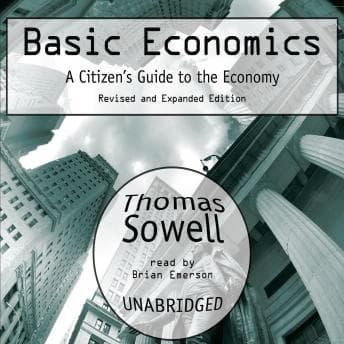
Let me get this out of the way: this is 18 and a half hours long. For an economics book. That's longer than the entire first Bobiverse book. And here's the wild part - I didn't want to skip a single chapter. Sowell does this thing where he takes a concept you think you understand (rent control, minimum wage, international trade) and methodically dismantles your assumptions using nothing but logic and real-world examples. No graphs. No equations. Just "here's what happened when Sweden did X" and "here's what happened when India did Y" and suddenly you're sitting there going, oh. OH.
The structure is basically a distributed systems architecture for understanding economies. Each chapter is a self-contained module that handles one domain - price controls, labor markets, international finance - but they all share the same underlying framework: incentives matter more than intentions. Once you grok that core principle, everything else clicks into place like microservices talking to each other through a well-designed API.
Sowell's writing is deceptively simple. He'll spend three paragraphs walking you through why rent control in New York led to housing shortages, then pivot to how similar policies played out in Hong Kong and Stockholm, and by the time he's done you realize he's taught you a general principle without ever stating it as an abstract rule. It's inductive reasoning done right. The international examples in this revised edition are genuinely what elevate it - he pulls from Soviet economic history, post-colonial African nations, Asian tigers, and European welfare states with equal fluency.
Now. Is Sowell politically neutral? No. He has a clear free-market orientation, and if you're coming in expecting a balanced "here are both sides" textbook, that's not this. He's arguing a thesis. But - and this is important - he argues it with data and historical evidence rather than ideology. You can disagree with his conclusions while still finding the analytical framework incredibly useful. I disagree with him on a few things. I still think the ROI on this audiobook is enormous. The closest analog I can think of for that experience - being genuinely persuaded by a framework you don't entirely agree with - was working through The Intelligent Investor, where Graham's value philosophy is argued so rigorously that even when I pushed back mentally, I came away with something useful.
Brian Emerson Does the Quiet Work
Brian Emerson narrates this, and he's... fine? Good, even. Look, this isn't a book that needs Ray Porter giving you six distinct alien species. It needs someone who can read clearly at a pace where your 6AM brain can actually process concepts like comparative advantage and price elasticity. Emerson delivers exactly that. His voice is steady, authoritative without being lecturing, and he handles the transition between Sowell's conversational explanations and his more pointed arguments without any jarring shifts.
The production is clean. No music, no sound effects, no gimmicks. Just a guy reading economics clearly enough that I could follow it on four hours of sleep after a 2AM deploy. That's the bar, and he clears it.
My one gripe: at 18+ hours, Emerson's delivery gets a little monotone during the chapters on international balance of payments. Not bad enough to lose me, but I did bump my speed up to 1.85x for a stretch there around hours 14-16. Your mileage may vary.
Who Gets the Most From This (And Who Should Look Elsewhere)
Perfect for: anyone in tech who makes decent money but has never actually understood why economies work the way they do. If you've ever nodded along in a conversation about monetary policy while secretly Googling "what is the Fed" under the table - this is your book. Also genuinely great for understanding why so many well-intentioned government policies produce the opposite of their intended effects. The chapter on healthcare economics alone is worth several commutes.
Skip if: you want a balanced academic survey of different economic schools of thought. This is Sowell's perspective, clearly and unapologetically argued. Also skip if you need narrative or story structure to stay engaged - this is pure educational content, chapter by chapter.
Perfect for: train, gym (surprisingly - the chapters are modular enough to work in 45-minute blocks). Skip for: bedtime. Your brain needs to be at least partially online.
The Commit Message
TL;DR: Worth your commute. Sowell turned 18 hours of economics into something I voluntarily listened to at 6AM on a packed Caltrain, and I came out the other side actually understanding price mechanisms. It's opinionated, it's long, and it could not have been a blog post. I mean that as the highest compliment I know how to give a business book. Took me about 8 commutes at 1.75x, and I'm already planning a re-listen of the chapters on labor markets.
Kevin asked me what I was listening to last Tuesday and I spent 20 minutes explaining why rent control creates housing shortages. He has not asked me about my audiobooks since.