
Look, I'm going to be honest about something that irritates me: WWII historical fiction has become its own kind of comfort food. You know the formula. Plucky protagonist. Impossible odds. The good guys win because D-Day. Publishers keep cranking them out like — well, like baguettes from an occupied bakery. So when I picked up The Baker's Secret, I was bracing myself for another slice of wartime sentimentality wrapped in a bow.
I was wrong. Mostly.
The Flour and the Straw
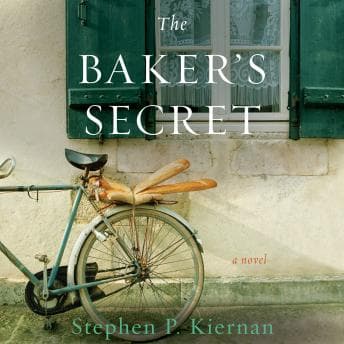
Here's what Kiernan does that caught me off guard: he builds the entire novel around an act of quiet arithmetic. Emma gets flour rations to bake twelve baguettes for German soldiers. She stretches it — cutting with ground straw — to produce fourteen. Those two extra loaves become currency, leverage, survival. It's not espionage. It's not romance. It's math and yeast and desperation, and honestly? That restraint is what makes the book work.
I was walking the lakefront with Denise on a Saturday morning, the kind of late spring day where Chicago pretends it's actually a livable city, and I found myself slowing down because the pace of the narration demanded it. Kiernan writes Emma as someone who has trained herself not to hope. She doesn't rage against the occupation — she calculates around it. The barter network she builds is less Casablanca and more like watching someone play chess with groceries. Howard's End gave me that same feeling — a novel that operates through social maneuvering and quiet pressure rather than anything so crude as a plot event. There's a patience to it that I genuinely respected, even when part of me wanted the story to pick up its feet.
And here's the thing about Ezra Kuchen, her mentor — the baker who taught her everything before the Germans dragged him away. Kiernan doesn't give us a dramatic farewell scene. Ezra is just... gone. The absence is the whole point. This reminds me of what Hemingway said about the iceberg theory — what's left unsaid carries more weight than any tearful goodbye could. Emma never processes the loss out loud. She just keeps baking. The prose deserves to be savored in those moments.
Cassandra Campbell Knows What Silence Is For
Campbell narrates at a register that took me maybe forty minutes to fully settle into. Her voice has this quality — penetrating is the right word, actually — where she doesn't push emotion at you. She lets it accumulate. The narrator understands that pause is punctuation. When Emma discovers what's happened to certain villagers, Campbell doesn't break into theatrical grief. She goes quiet. She lets the sentence land. And then she moves on, because Emma moves on, because what else can you do under occupation?
Now, I wish I could tell you she gives distinct French accents to the villagers or a chilling German edge to the soldiers — the research doesn't support that, and I honestly couldn't identify sharp character differentiation. What Campbell does instead is modulate tone and tempo. The German captain sounds different from the village priest not because of accent work, but because Campbell shifts her emotional register. It's subtler than I usually prefer, but it fits the book's temperament.
At 1.0x — because the author chose those words — the pacing feels deliberate rather than slow. But I'll admit: there's a stretch in the middle hours where the daily rhythms of occupation start to blur. The barter scenes repeat their emotional beats. You feel the monotony, which is arguably the point, but knowing the author intended something doesn't always make it engaging to listen to at 11 PM while circling red ink around run-on sentences in sophomore essays.
Where D-Day Actually Earns Its Weight
What surprised me most is how Kiernan handles June 6th itself. After hours of this controlled, interior, almost domestic novel about bread and survival and small defiances, the invasion arrives and the prose doesn't suddenly become a Michael Bay screenplay. The violence is ugly, chaotic, and deeply personal. Villagers die — not heroically, just randomly. The liberation isn't clean. Emma doesn't weep with joy at the sight of American soldiers. She's too exhausted for that. Too changed.
Let's talk about what Kiernan is really saying: freedom doesn't arrive like a parade. It arrives like a mess. And the people who survived occupation don't get to simply be grateful — they have to figure out how to live again without the terrible structure that gave their suffering a shape. That's not a message you get from most WWII fiction, and it's the reason I think this book earns its place on the shelf.
My students would hate this. I love it. (They'd want more action. They'd want Emma to blow something up. They are sixteen and wrong about many things.)
Who Needs This on Their Shelf
If you loved All the Light We Cannot See, this is its spiritual successor in spirit — quieter, less lyrical, more concerned with the economics of survival than the poetry of it. If you need plot momentum and constant tension, this will test your patience. If you're the kind of listener who appreciates a novel that trusts you to sit with discomfort, to find the heroism in an extra loaf of bread? Worth pausing the faculty meeting for.
The Grade I'd Write in the Margin
A strong, understated WWII novel elevated by Campbell's measured performance. Not flashy. Not fast. But genuine in a genre that too often settles for sentiment. I'd assign this to my AP students and dare them to find the courage in the quiet parts.