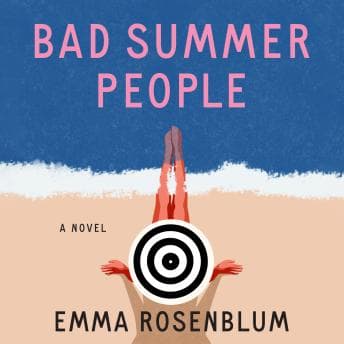

Every single person in this book is terrible. And I mean that as both a warning and a compliment.
I was chopping onions for a chana masala at 9 PM on a Tuesday — the kind of elaborate weeknight cooking my mother would call "unnecessary for one person" — when I started Bad Summer People, and I'll be honest, for the first hour I kept pausing to ask myself: do I actually care about any of these people? Jen Weinstein and Lauren Parker, the self-appointed queens of Salcombe, Fire Island, are the kind of women who weaponize brunch invitations. Their husbands carry grudges like heirlooms. Their single friend Rachel is — and I say this clinically — exhibiting textbook anxious attachment patterns while scanning the beach for someone else's husband. Nobody here is sympathetic. Nobody.
And yet I kept listening.
The Psychology of People You Love to Diagnose
Here's what Emma Rosenblum gets right: the social dynamics of insular wealthy communities operate exactly like high school, except everyone has a mortgage and a drinking problem. The protagonist exhibits classic status-anxiety behavior — Jen's constant mental ranking of who's wearing what on the ferry, Lauren's need to control the tennis court social hierarchy — and what makes these characters work (psychologically, at least) is that their motivations are petty in ways that feel true. Nobody's committing murder over grand philosophical differences. They're doing terrible things because someone got a better house rental. The social stakes feel just as suffocatingly small — and just as lethal — in Nine Lives, where the pettiness of closed communities does similar damage. Because someone's husband looked at someone else's wife for three seconds too long. The research actually shows that most interpersonal violence stems from perceived status threats, and Rosenblum — former editor at ELLE and Glamour — clearly understands this ecosystem from the inside.
The scene early on, with the women arriving on the ferry in coordinated dark sunglasses like some kind of bougie Hitchcock lineup, made me laugh out loud over my simmering onions. It's funny because it's observed. Rosenblum isn't inventing these people; she's transcribing them.
But here's where I found myself asking: why does the mystery element feel so secondary? The body doesn't show up until you're well into the story, and by then you've spent hours soaking in marital resentments and tennis drama. If you come expecting a thriller with a capital T, you'll be disappointed. This is a domestic drama wearing a mystery's clothing. Think White Lotus — everyone compared it to that, and they're right — where the "who did it" matters less than the "why are all these people so awful to each other."
January LaVoy Carries This Cast on Her Back
Let me be direct: without January LaVoy's narration, I'm not sure this book works in audio. You've got — I lost count — at least eight or nine major characters who are all roughly the same demographic: affluent, white, 30s-to-40s, East Coast. Distinguishing them vocally is a nightmare assignment. LaVoy pulls it off by giving each character subtle but distinct vocal signatures. The scratchy condescension she brings to certain characters versus the performative sweetness of others — it creates an instant social map. You know who's talking without the attribution tag.
Her comedic timing is the real secret weapon here. Rosenblum's prose has this dry, deadpan quality — observations about who's drinking too much rosé, who's pretending not to notice an affair — and LaVoy delivers those lines with exactly the right amount of bite. She doesn't oversell the jokes. She lets them land like gossip whispered poolside.
I bumped the speed to about 1.25x around hour three and it improved the pacing considerably. At normal speed, the middle section drags — there's a stretch where the social maneuvering starts feeling circular, same dynamics repeating in slightly different configurations. Speeding up tightened the tension.
Who This Is Really For (And Who Should Walk Away)
If you need a likable protagonist, skip this entirely. I'm serious. Not one person here would pass a basic "would you want to get coffee with them" test. My therapist would have thoughts about every character in this book, and none of those thoughts would be kind.
But if you're the type who watches reality TV and finds yourself genuinely fascinated by the group dynamics — why this alliance forms, why that betrayal happens, what social currency is being traded — then this is a fascinating case study in wealthy suburban tribalism. It's beach reading that thinks it's smarter than you, and sometimes it actually is.
The twist at the end kept me guessing, I'll give it that. Rosenblum plays fair with the clues but buries them under so much social noise that you don't notice until the reveal clicks. Psychologically, this tracks — we miss what's right in front of us when we're distracted by status games. That's true in the book and, honestly, in life.
My Case Notes
This is a 3.5-star audiobook elevated to a solid listen by LaVoy's performance and Rosenblum's sharp observational eye. It's not deep. The characters are surfaces reflecting other surfaces. But sometimes that's the point — and sometimes that's enough for a Tuesday night alone with good food and bad people.