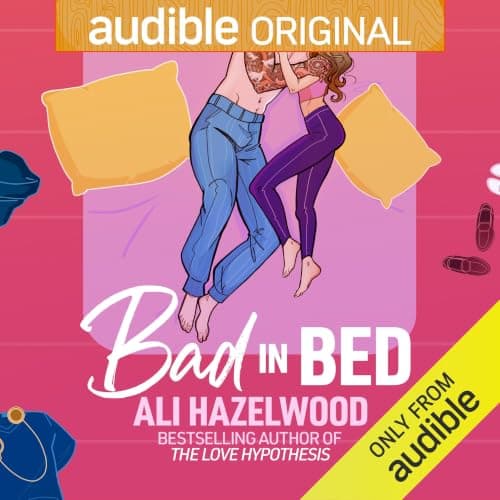

I have a methodological complaint. Billie van Buren is a statistics doctoral student, and her response to a public humiliation is an experiment with a sample size of one, no control group, and a co-investigator she's spent years trading insults with. Max Austin would never get past an ethics board. (I'd know. I've sat through enough accessibility audits to spot a protocol with no exit plan.)
I drafted that complaint on the Bainbridge ferry, in a window booth on the passenger deck. Engine rumble came up through the floor, and a toddler two booths over was having opinions. Bad conditions for my hearing aids, which made it a useful stress test. Could a full-cast romance stay intelligible over diesel and a tantrum? Mostly, yes. That ended up mattering more than the premise.
The ex's cruelty is the inciting incident, and it stays sore
The setup is blunt. Billie's years-long engagement ends, her family is disappointed, the friend group starts splitting along breakup lines, and her ex publicly trashes her in bed. Hazelwood doesn't play that last part for laughs. Everything Billie does afterward comes out of that wound, including asking Max for hands-on help.
What I liked is that her statistics skills are what actually bring them together. Billie's confidence lives in data. Max's confidence lives everywhere else. So the arrangement reads like her trying to manage feelings the only way she trusts, and that's a sharper hook than a lot of fake-dating setups.
Is the arc predictable? Yes. If you've heard Love on the Brain or Love, Theoretically, you know the rhythm: smart woman, academic orbit, a man softer than his reputation. This one puts Billie's own pleasure and self-image ahead of lab politics, and it's spicier. If you're new to Hazelwood, though, the formula won't bother you at all. If you want to separate plot from production, Love, Theoretically runs on much the same rhythm with Thérèse Plummer narrating, so the story stays familiar and only the voices change.
Sixteen performers, and I never lost the friend group
The cast is huge: Lee Osorio, Kelli Tager, Dina Pearlman, Marc Vietor and a dozen more, covering friends, family and colleagues. From my seat, that's good access design. In a single-narrator romance, group scenes make me decode speakers from small pitch shifts inside one throat, and that's tiring. Here, different people sound like different people. The scenes where the friend group takes sides after the breakup were easy to follow even over the engine noise, which I can't say for most ensemble romances.
That's also the clearest contrast with Problematic Summer Romance. That book is a traditional two-voice recording, Elizabeth Lamont and Eric Nolan, of an age-gap romance at a destination wedding, and nearly all the weight sits on the couple. Bad in Bed is audio-first and built around a crowd, because Billie's breakup ripples through everyone she knows. If you're unsure whether you prefer Hazelwood as an intimate duet or as an ensemble production, listen to both and you'll know.
Brooke Bloomingdale carries Billie's side well. When Billie argues herself toward asking Max for help, then half-retreats, then pushes forward again, I could follow the back-and-forth without the text open. I usually miss that kind of hesitation in real conversation, so it counted for a lot. If you know her from the holiday banter of Wreck the Halls: A Novel, Billie asks for a tighter, more anxious register, and she gets there. Bloomingdale also narrates Rebel, and I'd go there next to see how she handles a different kind of lead.
Hamilton's Max, before and after the confession
One Goodreads reviewer admitted to "Teddy Hamilton fatigue," and I came in braced for it. He narrates a lot of romance leads. Early Max sounds like exactly that: warm, easy, a little smug, the teasing frenemy on autopilot.
That familiarity turns out to be useful. The love confession, which listeners keep singling out, lands because it doesn't sound like the teasing Max we've been hearing for hours. It's quieter and less performed. It reached me more clearly through my aids than a raised voice would have. Another reviewer described his Max as a man slowly coming undone, and the confession is where that pays off.
My accessibility caveat: during the intimate scenes I kept nudging the volume up, then down again when a supporting cast member came in at normal level. That's a dynamic-range trade-off, and hearing listeners may never notice it. I noticed every time. With no companion text to check a low line against, I had to rewind twice.
Is this your 8h 41m?
Queue this up when you want a spicy frenemies-to-lovers story where a big ensemble stays effortless to track and a familiar Hazelwood blueprint feels comforting rather than tired. Pass on it if a breakup sparked by public sexual shaming will sour the premise for you, if Hamilton's ubiquitous romance-lead cadence has worn thin, or if quiet, whisper-level scenes without a companion transcript tax your hearing.
My memo to Audible, stapled to a yes
The 4.79 average is rewarding Hamilton's confession and the cast more than the story, and I think that's fair. For the full package I land at 4.4. The performances and ensemble clarity are worth the credit, and the predictable arc and volume juggling keep it out of top tier. Spend it. And publishers, ship a transcript with audio-first romance. Some of us need one.