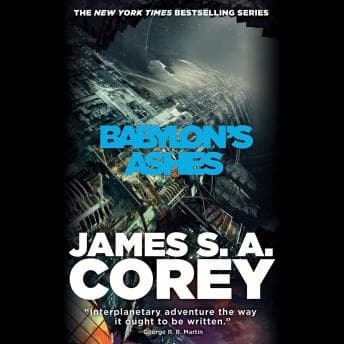

Look, I'm gonna be honest with you - I started this one at 2 AM because I couldn't sleep after finishing Nemesis Games, and I regret nothing. Twenty hours later, my thesis is still unwritten, but I have feelings about Belter politics now. This is the problem with The Expanse series. You can't just listen to one.
The POV Explosion That Actually Works
So here's the thing about Babylon's Ashes that threw me at first: there are a LOT of point-of-view characters. Like, way more than the previous books. We're jumping between the Rocinante crew, Free Navy leaders, Earth politicians, and random Belters whose names I kept having to remember. My D&D group would call this "splitting the party" and normally I'd be annoyed.
But honestly? It works. Corey (or rather, the two dudes who ARE Corey) use all these perspectives to show how the solar system is literally falling apart from every angle. You get the Free Navy thinking they're freedom fighters while you're watching them murder colonists. You get Earth trying to rebuild while millions are starving. The progression of the political collapse is satisfying in that horrible way where you can see exactly how everything went wrong.
The pacing does drag in spots - I won't lie. There are sections in the middle where we're doing a lot of setup and positioning, and I found myself zoning out during some of the logistics discussions. But when things click into place? When the Rocinante finally makes its move? Chef's kiss. This is Sanderson-level world-building applied to hard sci-fi, and I am here for it.
Jefferson Mays Walked So Other Narrators Could Run
Okay, can we talk about Jefferson Mays for a second? Because this man is doing the Lord's work with like fifteen different accents and somehow I can tell every single character apart. His Avasarala is perfection - that gravelly, profanity-laced delivery that makes you feel like you're getting dressed down by the scariest grandma in the solar system. His Amos is this flat, almost-too-calm menace that's exactly right.
But what really gets me is his Belter accents. The way he shifts into that patois for different characters, giving each one their own flavor while still making it sound like they're from the same culture? That's craft. That's someone who actually thought about how language works in space. Steven Pacey is still my narrator god, but Mays is absolutely in the pantheon. Though honestly, even pantheon-tier narrators can't save every book—I'm still recovering from the narrator mismatch in Heart Seeker.
There are moments where the narration can feel a bit dry during the more technical sections - like when we're deep in fleet movements and supply chain logistics. But that might be the material more than Mays. You can only make "they calculated fuel reserves" sound so exciting.
The Emotional Gut-Punches Hit Different
Without spoiling anything, this book deals with the aftermath of Nemesis Games in ways that actually hurt. The Earth attack wasn't just a plot point - it's a wound that every character is carrying. Watching Naomi deal with what her son has become, watching Holden try to hold together alliances that keep fracturing, watching Avasarala rebuild from literally nothing - it's heavy stuff.
And the Free Navy as antagonists are frustrating in the best way. Marco Inaros is such a well-written villain because you can see exactly how he convinced people to follow him. He's charismatic and he's not entirely wrong about Belter oppression. He's just also a narcissistic monster willing to kill billions for his ego. My D&D group would love to hate him.
The ending sets up the next phase of the series in a way that had me immediately downloading Persepolis Rising. (My advisor is going to be so disappointed in me. Sorry, Dr. Patel.)
Roll for Initiative (Or Don't)
If you're not already five books deep into The Expanse, this is absolutely not the place to start. Go back to Leviathan Wakes. But if you've been following along, this is essential. Yes, it's 20 hours. Yes, it drags in spots. Yes, there are maybe too many POV characters. But the payoff is worth it, and Mays' narration elevates material that could feel like homework into something genuinely compelling.
Skip this if you hate info-dumps or political maneuvering. But if you're the type who reads wiki articles about fictional governments for fun? You're my people. This is your jam.