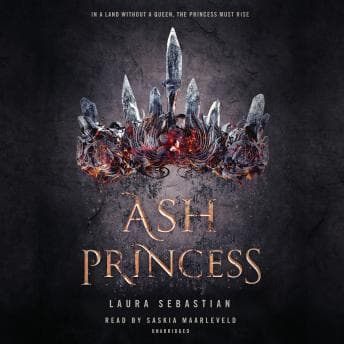

This book made me miss my stop. Twice.
Look, I don't usually go for YA fantasy—I'm more of a hard sci-fi person who needs her physics to check out. But I grabbed Ash Princess on a whim after a brutal week of on-call rotations, and honestly? It scratched an itch I didn't know I had.
The Pacing Problem (And How to Fix It)
Bottom Line: Listen at 1.25x minimum. Trust me on this.
At normal speed, Saskia Maarleveld's narration drags like a Monday morning standup that should've been a Slack message. The book is 13+ hours, and at 1.0x, you'll feel every single one of them. But here's the thing—bump it to 1.25x and suddenly the pacing clicks. The emotional beats land harder, the political scheming feels urgent, and Theo's internal monologue stops feeling like she's journaling and starts feeling like she's plotting.
I tested this theory by switching back to 1.0x during a slower chapter and immediately regretted it. The difference is night and day.
Maarleveld's Emotional Pivot Game
Where the narrator really earns her keep is in Theo's emotional range. This girl goes from playing docile prisoner to cold strategist to barely-contained rage in the span of a single scene, and Maarleveld pivots on a dime. When Theo's putting on her mask for the Kaiser's court, there's this thin, careful quality to the voice—you can hear her calculating. When that mask slips and the anger bleeds through? It's visceral.
The thing is, Theo is kind of insufferable sometimes. She makes choices that had me muttering "girl, no" on a packed 6AM train (got some looks for that one). But Maarleveld sells her cleverness so well that even when I wanted to shake Theo, I understood why she thought her terrible plan would work. That's solid character work.
The "Could've Been a Blog Post" Syndrome
Okay, real talk: this book has some YA tropes that made my eyes roll so hard I nearly pulled a muscle. There's a love triangle brewing that feels obligatory rather than earned. The worldbuilding—fire magic, oppressed kingdom, cruel empire—is functional but not exactly breaking new ground. If you've read Red Queen or An Ember in the Ashes, you'll recognize the furniture.
But here's why it still works: the political scheming is genuinely clever. Theo's weapon is her brain, and the book actually follows through on that premise. She's not secretly a chosen one with hidden powers (at least not in book one). She's just smart, traumatized, and really, really angry. The ROI on this audiobook is in watching her outmaneuver people who underestimate her.
Content Warning: This Gets Dark
I should mention—this book doesn't pull punches on the abuse and violence. Theo has spent ten years as a prisoner being publicly humiliated and worse. The book doesn't wallow in it, but it doesn't shy away either. There's a scene early on where the Kaiser forces her to do something genuinely awful, and it sets the stakes in a way that stuck with me. Not great for half-asleep morning commutes if you're sensitive to that stuff.
Who's This Actually For?
Perfect for: train, gym, any situation where you can focus but don't need your full brain. Skip if you need original worldbuilding or can't stand love triangles—this one's got both. Also skip for bedtime (too engaging) or background listening (you'll miss the political maneuvering).
I finished this in about 5 commutes at 1.25x, and by the end I was annoyed that book two wasn't already in my library. It's not going to revolutionize the genre, but it's a solid execution of the "prisoner princess plays the long game" premise. Maarleveld's emotional range elevates material that could've felt generic in lesser hands.
Kevin asked why I was so invested in "another fantasy book about a girl with a color in her title" and I couldn't even explain it. Sometimes you just need to watch someone smart burn down the system from the inside. The Nightingale scratched that same itch for me—watching women navigate impossible systems with nothing but their wits. Especially during on-call week.