
Ever wonder why, after a twelve-hour shift of dealing with bodily fluids, drunk drivers, and the general chaos of a Level 1 trauma center, the only thing that actually lowers my blood pressure is a story about a three-century-old immortal and a wolf-shifter fighting a dark goddess?
Yeah, me neither. I just accept it.
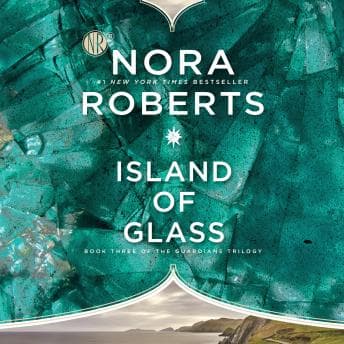
I listened to Island of Glass on the drive home this week—mostly between 3:30 AM and 4:15 AM—and honestly? It saved my sanity. This is the third book in the Guardians Trilogy, and usually, by book three, I'm ready to tap out. (Yes, I have commitment issues with series. Don't analyze that.) But Nora Roberts knows exactly what she's doing, and apparently, so does Saskia Maarleveld.
No Fake Accents Here, Thank God
Look, I work with people from everywhere. I have an ear for accents. Nothing—and I mean nothing—makes me yell at my car dashboard faster than a narrator butchering an Irish brogue. It's like nails on a chalkboard or a monitor alarm that won't shut off.
But Saskia? She nailed it.
Doyle is the main focus here—he's the "immortal warrior" type—and his voice needs to sound ancient, weary, and distinctly Irish without sounding like a cereal mascot. She pulls it off. It's deep, it's grounded. (Carlos asked me why I was sitting in the driveway for ten minutes after I got home. I told him the engine needed to cool down. Truth is, I just wanted to hear Doyle finish his monologue.)
She also manages to juggle six main characters without me losing track of who's talking. Do you know how hard that is? I can barely keep track of three interns during rounds. She switches from Annika's sweetness to Riley's practical, sharp tone without missing a beat.
The "Grumpy Surgeon" Energy
So the story centers on Doyle and Riley. Riley is an archaeologist (cool) and a wolf (very cool). Doyle is... well, he's basically every grumpy trauma surgeon I've ever worked with, just with a sword instead of a scalpel. Closed off. Tragic past. Thinks feelings are a weakness.
I loved their dynamic. It's not instant mushy love—it's friction. Riley is practical. She doesn't take his brooding nonsense. I relate to that. When you're in the thick of a crisis—or in their case, hunting for the Star of Ice—you don't have time for drama. You just need to get the job done.
The pacing is solid, too. Sometimes fantasy romance can get bogged down in the "lore" (which usually puts me to sleep on the I-10), but this kept moving. The shift to Ireland for the setting was perfect. It felt atmospheric—rainy, green, dangerous. A nice contrast to the dry heat of Phoenix.
Coffee's Brewing, Book's Done
Is it high art? No. Is it medically accurate? Well, there's magic, so I can't exactly critique the physiology of a shape-shifter. (Though I'm pretty sure shifting bone structure that fast would require way more calorie intake than they show. Just saying.)
But for a post-shift decompression? It's gold. It's got that comfort-food vibe that Nora Roberts is famous for, but the narration elevates it to something way more engaging. That same cozy reliability is what makes Perfect Hope work so well—Roberts knows her formula, and she executes it perfectly. I didn't zone out once.
My mom would love this—she's always telling me I need more "romance" in my life, though I think she just wants grandkids. She already burned through Finding the Dream in like two days, so I know she'd eat this up. I might actually recommend it to her.
Who's This For?
If you need something to decompress after long shifts, love paranormal romance with actual banter instead of insta-love, or just want a narrator who won't butcher accents—this is your book. Skip it if you haven't read the first two (you'll be lost as a med student on their first day) or if you need hard magic systems with detailed rules. This is comfort food, not a textbook.