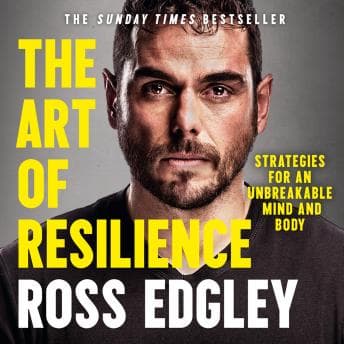

I was stress-cleaning my apartment at midnight — the kind of cleaning you do when a client ghosts you on a $3,000 branding project and you need to channel the rage somewhere productive — when Ross Edgley started telling me about the time his tongue literally disintegrated from saltwater exposure during his swim around Great Britain. And I just... stopped scrubbing the stovetop. Stood there with a sponge in one hand, phone in the other, genuinely bewildered. Because here's this man describing his tongue falling apart like wet paper, and he sounds delighted about it.
This book is so far outside my usual lane it might as well be in a different zip code. I live in romance and memoir and stories that make me ugly-cry into my pillow. But sometimes you need a book that grabs you by the shoulders and says "your problems are not that serious," and this one did that with a weird, infectious cheerfulness I wasn't expecting.
The Guy Who Ran a Marathon Dragging a Car Wants to Talk About Feelings
Okay not feelings feelings. Not the kind I usually chase. But Ross Edgley does something interesting here — he structures the whole book around his 157-day swim, opening each section with his location and how many days he's been at sea, and then weaves in sports science, Stoic philosophy, and stories from his other bonkers adventures. Like living with Yamabushi warrior monks in Japan. Or doing pain rituals with fire ants in the Amazon. (Abuela would have crossed herself so hard at that part, honestly.)
The thing is, he's genuinely funny about it. There's this self-deprecating warmth running through everything — he's not performing toughness the way a lot of these extreme athlete types do. He pulled a 1.4-tonne car while running a marathon and he talks about it like it was a slightly weird Tuesday. The humility keeps it from ever feeling like a lecture, which is where books like this usually lose me.
That same unshowy, been-there-done-that quality is what worked for me in Unmasked: My Life Solving America's Cold Cases — another book where the author's lived experience carries the whole thing.But I'll be honest — the science parts are... uneven. He throws around references to studies and psychological concepts, and sometimes it feels more like enthusiastic name-dropping than rigorous analysis. I've seen other readers call this out too, and they're not wrong. If you want deeply cited, peer-reviewed sports psychology, this probably isn't your book. If you want a very likable man telling you insane stories while occasionally explaining why your brain quits before your body does? Pull up a chair.
Ross Narrating Ross Is Exactly What This Needed
Here's where the audiobook format actually earns its keep. Ross narrates this himself, and — look, I'm a Julia Whelan devotee. I worship at the altar of professional narration. A trained narrator would have given this more polish, more dynamic range, more vocal texture.
But they wouldn't have given you Ross.
There's something about hearing him describe swimming through a field of jellyfish at 3 AM in his own voice — genuinely warm, a little breathless with the memory of it, laughing at his own misery — that a professional narrator simply cannot replicate. You believe him because he's not performing the story. He's remembering it. The delivery is conversational, almost like he's telling you this over a pint, and while it lacks the dramatic range I usually crave, it works because the content is so inherently wild that it doesn't need vocal fireworks.
That said, it's 10 hours. And around hour 6 or 7, when he's deep into the philosophical framework stuff, his energy stays pretty level. No real vocal valleys or peaks to carry you through the denser material. I caught myself drifting a couple times during the more abstract sections — and I listen at 1.0x always, so speeding up wasn't an option for me. (I mean, it's always an option. I just refuse on principle.)
Did This Make Me Cry Though?
No. And that's okay. Not every book has to wreck me. But it did make me feel something I don't feel often enough — this fizzy, restless energy, like I wanted to go outside and do something difficult just to prove I could. I redesigned that ghosting client's entire brand deck the next morning in four hours, fueled by spite and Ross Edgley's voice in my ears telling me about swimming through whirlpools that locals said were haunted.
This book felt like a shot of espresso disguised as a memoir. It's not going on my crying spreadsheet, but it earned a different kind of spot — the "books that made me do something" list. Which, now that I think about it, I should start tracking.
Frida sat on my keyboard through most of it. Diego ignored me entirely. Standard reviews from the household critics.
Who Needs This in Their Ears
If you work out and want motivation that's smarter than a generic podcast bro screaming at you — yes. If you like memoir-adjacent nonfiction where the author has actually done ridiculous things and isn't just theorizing — yes. If you want that same real-world stakes energy applied to political power instead of physical endurance, Passage of Power scratches a similar itch in a completely different arena. If you need meticulous citations and academic rigor — maybe look elsewhere. And if you're like me, a romance-and-feelings person who occasionally needs to be shaken out of your comfort zone by a man whose tongue fell apart in the ocean — honestly? Give it a shot. You might surprise yourself.