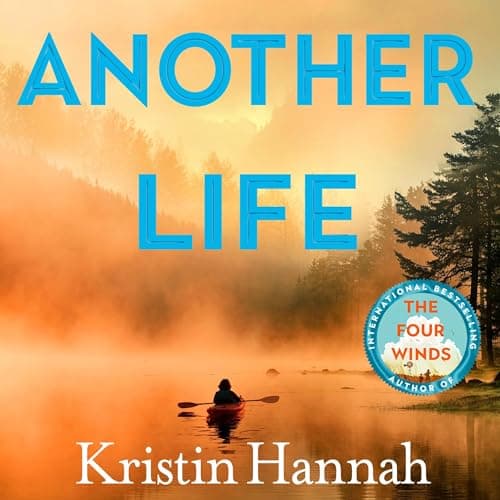

What happens when a horror podcast host picks up a Kristin Hannah novel?
I'll tell you what happens. It's 11 PM, I'm reshelving returns at the branch because we're short-staffed this week, and I've got my earbuds in expecting to queue up the next episode edit for The Witching Hour. But I'd promised myself I'd branch out - pun intended - and Another Life had been sitting in my library for weeks. Pacific Northwest small town? A woman returning to her coastal childhood home? I live in Oregon. I felt personally targeted.
So here's the thing. I don't typically review contemporary fiction. My world is dread, atmosphere, the slow unraveling of sanity. But Another Life does something that caught me off guard: it builds tension the way good horror does. Not with monsters or hauntings, but with the creeping certainty that something is about to go very, very wrong for people you've started to care about.
The Dread of Wanting Something Too Much
Angie DeSaria's story is fundamentally about hunger - years of fertility treatments, a marriage that collapsed under the weight of that wanting, and a retreat back to a small coastal town where she's supposed to save the family restaurant. Lauren Ribido is the inverse mirror: a high school senior desperate to escape her hometown and a mother who can't hold it together long enough to be present. When Lauren's mom skips town entirely, Angie takes her in, and the novel sets up this gorgeous, aching dynamic between two people filling each other's voids.
Here's where I surprised myself. I grew up in a household where emotional need was something you prayed away. You didn't talk about infertility. You didn't talk about absent parents. You certainly didn't form messy, boundary-blurring relationships to cope. Hannah writes directly into that silence, and it hit harder than I expected.
The tension doesn't come from external threats. It comes from the slow realization that Angie's kindness toward Lauren isn't purely altruistic - there's a desperate maternal longing underneath it that's going to cost both of them. That's horror-adjacent, honestly. The monster is need itself.
Susan Ericksen Knows What She's Doing
I have a firm rule: if the narrator doesn't commit, I'm out. Susan Ericksen commits. She doesn't oversell the emotional beats - and in a book this loaded with grief and longing, overselling would've been fatal. Her Angie carries this quiet brittleness, like someone holding their breath through every interaction because exhaling might break something. Her Lauren is sharper, more guarded, with a younger cadence that shifts as the character grows.
What impressed me most was pacing. There are scenes - Angie alone in her childhood home, processing the full weight of her failed marriage and empty arms - where Ericksen lets the silence do work. She doesn't rush to fill emotional space with vocal gymnastics. She sits in it. At 1x speed, those pauses land exactly right. (Some listeners apparently enjoyed 1.5x, and sure, you can, but you'll lose those beats. Your call.)
No sound effects, no music, no full cast. Just Ericksen and the text. Solo narration done with intention.
Where the Cracks Show
Look, I'd be lying if I said this was flawless. The plot mechanics are visible in places - you can feel the story being engineered toward its emotional payoffs, particularly in the third act when the "far-reaching repercussions" the blurb promises finally arrive. Hannah is a skilled architect, but sometimes the scaffolding peeks through. If you've read The Great Alone or Night Road, you know her pattern: build empathy, establish bonds, then detonate something. Another Life follows that blueprint pretty faithfully.
And Lauren's character, while well-voiced by Ericksen, occasionally reads more like an adult's idea of a determined teenager than an actual teenager. Her Ivy League ambitions feel like character shorthand rather than something deeply explored.
But these are structural quibbles. The emotional engine works. By hour nine, I was sitting in my car in the library parking lot, engine off, not going inside because Ericksen was in the middle of a scene and I physically could not press pause.
Who Should Listen (And Who Should Skip)
You'll connect with this if you want fiction that treats infertility and found family with real weight, not sentimentality. You'll also connect if you appreciate a narrator who trusts silence as much as speech.
Skip it if you need plot momentum over character interiority. This is a slow burn in the truest sense - it rewards patience, not impatience. And if you're exclusively a genre reader like me? This might stretch your comfort zone. But sometimes that's the point.
Shirley (My Cat) Was Unimpressed. I Was Wrecked.
I came to this expecting competent contemporary fiction and found something that genuinely unsettled me - not with fear, but with recognition. The wanting. The way love and selfishness get tangled up until you can't separate them. Hannah understands that the scariest thing isn't what lurks in the dark. Sometimes it's what you'd do for the person sleeping in your spare room.
My podcast listeners are going to be confused when I bring this up next episode. But good. Comfort zones are overrated. I had a similar reckoning when I reviewed Event — something I picked up sideways, expecting little, and walked away genuinely rattled by how much it had gotten under my skin.