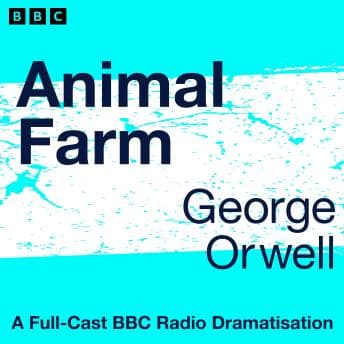

Everyone thinks they know Animal Farm. My students think they know it — they've read the SparkNotes, absorbed the memes, internalized "four legs good, two legs bad" as a punchline. And honestly? After twenty years of teaching it, I thought I knew it too. Then I listened to this BBC Radio 4 production during a Saturday morning walk along the lakefront and realized I'd been teaching a fable when Orwell wrote a funeral.
Let me explain.
What Orwell's Own Adaptation Gets Right That We Get Wrong
Here's the thing most people don't know about this production: it's based on Orwell's own 1947 dramatic adaptation. Not a modern screenwriter's interpretation, not some producer's "vision" — Orwell himself restructured his novel for performance. And the difference matters. The pacing is ruthless. At an hour and twenty-seven minutes, there's no fat on this thing. The revolution rises and falls in the time it takes to grade a stack of sophomore essays. But that compression works because Orwell understood something about his own story that most adaptations miss: the horror isn't in the violence. It's in how quickly everyone just... adjusts.
Nicky Henson's Napoleon is the perfect vehicle for this. He doesn't play the pig as a snarling dictator — he plays him as a committee chairman who's simply decided the committee no longer needs to vote. There's a bureaucratic flatness to his authority that's far more chilling than if he'd gone full villain. This reminds me of what Hemingway said about dignity under pressure, except here it's the absence of dignity dressed up as procedure.
And then there's Toby Jones as Squealer. If Henson's Napoleon is the fist, Jones is the press secretary — all smooth justification and statistical gymnastics. The way he pivots from "Comrade Napoleon has decided" to "Surely, comrades, you do not want Jones back?" with barely a breath between them — that's not just acting, that's political science performed aloud.
The Narrator Understands That Pause Is Punctuation
Tamsin Greig narrates with this quiet, almost documentary precision that does something unexpected: it makes you complicit. She's not telling you a cautionary tale. She's reading you minutes from a meeting you attended and chose to forget. Her delivery during the commandments' gradual revision — when "No animal shall sleep in a bed" becomes "No animal shall sleep in a bed with sheets" — is so matter-of-fact it lands like a gut punch. No dramatic music cue. No vocal emphasis. Just the calm recording of a lie that everyone agrees to accept.
The BBC production team earned their keep here. The sound design is restrained in the best possible way — barnyard ambiance, the distant sounds of construction on the windmill, the unsettling quiet after Boxer is taken away. They resist the urge to overproduced, which is exactly right for material this sharp. You don't need a film score to tell you something terrible just happened when the writing already did the work.
Eighty-Seven Minutes That Make Twenty Years of Teaching Feel Insufficient
I'll be honest — I've always taught Animal Farm as Orwell's "simpler" work. The one you assign before 1984. The warm-up. Listening to this production made me feel a little ashamed of that framing. The full-cast format strips away the comfortable distance of reading allegory on a page. When you hear the animals chanting, when you hear the dogs growl, when you hear the slow draining of conviction from Benjamin the donkey's voice — it stops being a clever parallel to Soviet history and starts being about every institution you've ever watched corrode from the inside. Black and Blue got under my skin the same way — that slow, institutional rot where everyone keeps their head down and calls it professionalism.
(Principal Martinez, if you're somehow reading this: I'm not talking about our school. Mostly.)
My students would hate this. I love it. They'd hate it because it's short enough that they can't zone out and long enough that they'd have to actually think. The prose deserves to be savored, and at 1.0x speed — the only civilized option — every carefully chosen word of Orwell's adaptation lands with its full weight.
Who Needs This in Their Ears
If you loved 1984 but found it overwhelming, this is its spiritual successor — or rather, its predecessor with sharper teeth. Perfect for anyone who thinks they already know Animal Farm. You don't. Not like this. Skip it if you want a straightforward audiobook reading of the novel — this is a radio drama, and it plays by different rules. The cast format means you're watching a play with your eyes closed, not being read to.
At under ninety minutes, this barely costs you a walk. But it'll rearrange how you think about a book you assumed you'd outgrown.
Worth Pausing the Faculty Meeting For
Denise asked me why I was so quiet when I got home from my walk. I told her I'd just listened to a story about pigs, and she gave me the look she reserves for when I'm being deliberately literary. But I meant it simply. Sometimes the oldest stories hit hardest when you finally hear them spoken aloud by people who understand what the silence between the words is doing. Forty-seven podcast listeners and twenty years of classroom experience, and a BBC radio play just taught me something new about a book I've assigned a hundred times. The irony isn't lost on me.