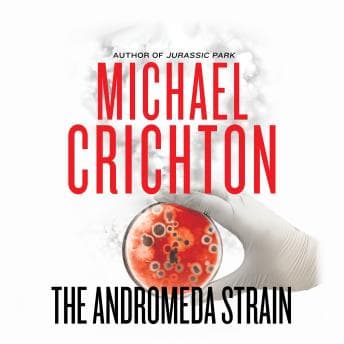

I'm gonna be real with you - I picked up The Andromeda Strain because I needed something to get me through a particularly brutal week of on-call rotations, and a 50-year-old sci-fi novel about a killer space virus seemed like exactly the kind of nerdy escapism my sleep-deprived brain required. What I didn't expect was to find myself genuinely stressed out on a packed Caltrain at 7AM, white-knuckling my phone like the fate of humanity actually depended on whether these fictional scientists could figure out their containment protocols.
Michael Crichton wrote this thing while he was still in medical school, and honestly? It shows - in the best possible way. The man understood how to make scientific procedures feel like edge-of-your-seat thriller material. This is basically a procedural drama but for biohazard containment, and I mean that as the highest compliment.
The Science Actually Holds Up (Mostly)
Here's the thing about Crichton - he does his homework. The Andromeda Strain reads like a technical manual that someone accidentally made riveting. There are pages dedicated to describing decontamination procedures, electron microscopy, and the layout of an underground government facility. And somehow? It works. The pacing never dragged for me, even during the dense scientific exposition, because Crichton understood that the process of discovery is inherently suspenseful when the stakes are "everyone might die."
Now, is some of the science dated? Sure. This was written in 1969, so the computer technology descriptions are adorably retro - there's a whole sequence involving paper printouts and punch cards that made me smile. But the core biological concepts and the methodical approach to problem-solving? Still compelling. As someone who debugs distributed systems for a living, I found the scientists' systematic elimination of hypotheses weirdly satisfying. They're basically running A/B tests on an alien organism. My kind of people.
The only thing that felt a bit pat was the ending - it resolves a little too neatly for my taste. But by that point, I'd been so thoroughly invested in the journey that I didn't really mind.
David Morse Nails the Clinical Urgency
David Morse isn't Ray Porter (nobody is), but he brings something really specific to this narration that works perfectly for the material. His voice has this gravelly, almost clinical quality that matches the dispassionate tone of the source material. When the scientists are discussing mortality rates and contamination protocols, Morse delivers it with the same calm intensity you'd want from an actual crisis response team.
What impressed me most was how he differentiated the characters without going full voice-actor-mode. The scientists each have their own subtle cadence - the older, more cautious researcher sounds different from the younger hotshot - and the military personnel have this world-weary gruffness that feels authentic. Someone in a Reddit thread compared him to Will Patton reading Stephen King, and yeah, I can see it. That same ability to make technical or procedural content feel urgent.
The production is clean, with some subtle sound effects that enhance key moments without being distracting. No complaints there.
Perfect Commute Material (With Caveats)
This is an 8-hour listen, which means I finished it in about four commutes. The chapter structure works well for train listening - natural stopping points, clear scene breaks. I never felt lost when I picked it back up after a day away.
That said, this isn't a half-asleep-at-6AM book. The scientific detail requires at least 70% of your brain to be online. I'd recommend this for the morning commute when you're caffeinated, not the evening ride when you're running on fumes. And definitely not for the gym - you'll miss too much during the heavy lifting.
Speed-wise, I ran it at 1.25x and it felt natural. Morse's deliberate pacing benefits from a slight bump, but don't go higher or you'll lose some of the tension he builds.
The Bottom Line
Worth your commute if you like your sci-fi grounded in actual science and your thrillers methodical rather than explosive. This is a procedural in the truest sense - the excitement comes from watching smart people solve an impossible problem under pressure. Nightfall scratches that same itch—scientists racing against an astronomical clock, methodical problem-solving under existential threat. The ending doesn't quite stick the landing, but the journey is genuinely engaging.
Queue it up if: you want hard science fiction that reads like a thriller, you appreciate systematic problem-solving, or you're a sucker for "scientists vs. extinction-level threat" stories. Skip it if: you need action-heavy pacing, character-driven drama, or something you can half-listen to while multitasking.
If you've never read Crichton before, this is actually a great starting point - it's leaner and more focused than Jurassic Park, and the audiobook format makes the technical passages easier to absorb than reading them on a page. Though honestly, Jurassic Park is still my favorite Crichton for pure commute entertainment—bigger scope, more chaos, and the narrator absolutely sells those dinosaur scenes. And if you're a Crichton fan who's only done his later work, going back to where it all started is kind of fascinating. You can see the DNA (pun intended) of everything that came after.