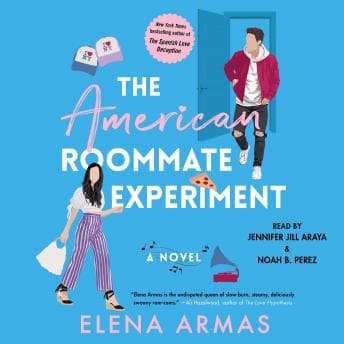

"I'll take you on dates. Experimental dates."
I nearly rear-ended a Prius when Lucas dropped that line around hour three. Post-night shift, running on four hours of sleep and hospital coffee, and this Spanish engineer is proposing fake dates to cure writer's block. My sleep-deprived brain was absolutely here for it.
Here's the thing about romance audiobooks after a twelve-hour shift in the trauma bay—they need to be uncomplicated comfort. Warm blanket energy. And The American Roommate Experiment delivers exactly that, even if the delivery itself has some... quirks.
When Your Knight Wears a Towel Instead of Armor
Elena Armas knows what she's doing with the forced proximity trope. Rosie's a secret romance writer with catastrophic writer's block, Lucas is her best friend's Spanish cousin who cooks and walks around half-dressed. The setup is pure wish fulfillment and I'm not mad about it. The experimental dates—where Lucas recreates romantic scenarios to inspire Rosie's writing—are genuinely creative. Farmers market at sunrise. Bookstore adventures. The kind of intentional romance that makes you side-eye your own husband's idea of a date. (Carlos, taking me to Home Depot doesn't count.)
What I appreciated: Rosie's anxiety feels real. The panic attacks, the self-doubt spiraling, the way she catastrophizes—that's not just plot device anxiety. Pride and Perdition handles similar mental health themes with that same authenticity. That's the kind I see in patients, the kind I've felt myself on brutal shifts. Armas writes it with enough accuracy that I wasn't yelling at my dashboard for once.
The Narration Situation (Let's Talk)
Okay. Here's where it gets complicated.
Jennifer Jill Araya handles Rosie's chapters, and Noah B. Perez takes Lucas. Dual narration for dual POV—makes sense. And when it works, it works. The romance hits different when you're hearing Lucas's perspective in a male voice, his internal swooning over Rosie matching her oblivious narration in her own chapters.
But.
Some listeners have compared Perez's voice to "a mix between Chuck Bass and Vito Corleone" and I can't unhear it now. He sounds... not particularly Spanish? Which is distracting when Lucas's Spanish heritage is literally a character trait. And Araya has this slightly jumpy cadence that took me a few chapters to adjust to. By hour six I'd stopped noticing, but those first few hours required patience.
I ended up bumping to 1.25x speed during slower sections. At nearly fifteen hours, this book takes its sweet time. The pacing drags in the middle—lots of internal monologue, lots of Rosie spiraling about her feelings. At normal speed, some sections felt like being stuck in a waiting room. Speed adjustment helped.
Comparing Notes with Lina's Story
If you listened to The Spanish Love Deception, you'll recognize the vibe. Same universe, same friend group, similar beats. Lucas is Lina's cousin, so there's connective tissue there. But where Catalina and Aaron had that enemies-to-lovers tension, Rosie and Lucas are pure sweetness from the jump. Less friction, more mutual pining.
Some people prefer the first book's dynamic. I found this one more relaxing—which, after intubating a combative patient at 4 AM, is exactly what I needed. Not every romance needs conflict. Sometimes you just want two good people figuring out they're good together. That same gentle energy shows up in Dilemma: A Novel, where the stakes stay refreshingly low.
Who's Going to Love This (And Who Should Keep Scrolling)
Queue it up if: You want comfort food romance. You like forced proximity and fake dating. You're okay with slow pacing if the payoff is sweet. You need something that won't require intense focus.
Skip it if: You need fast-paced plots. Narrator voice quirks pull you out of stories. You found The Spanish Love Deception too tropey—this is more of the same.
Clocking Out
Carlos asked why I was smiling at my steering wheel three mornings in a row. I blamed the sunrise. It was definitely Lucas making Rosie breakfast and being devastatingly earnest about it.
Is this groundbreaking literature? No. Is the narration perfect? Also no. But sometimes you need a book that feels like a hug, where the biggest conflict is two people being too scared to admit they're falling for each other. After fifteen years of watching actual medical emergencies, I'll take fictional problems about apartment-sharing and writer's block any day.
Just maybe speed it up a little. Your commute will thank you.