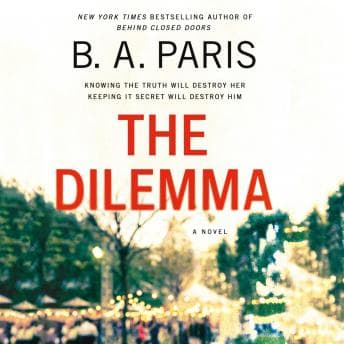

Most people come to B.A. Paris for the adrenaline. Behind Closed Doors was a sprint; The Dilemma is a marathon run in lead boots. I gave Behind Closed Doors four and a half stars specifically because it never let me breathe—this one asked me to sit in the suffocation instead. I went in expecting a thriller—something to keep me on edge while I cataloged new arrivals in the library basement. Instead, I got a nine-hour panic attack centered around a 40th birthday party.
Here's the thing about horror: it doesn't always need a ghost. Sometimes, the scariest thing is simply knowing a devastating truth that everyone else in the room is oblivious to. That's the entire engine of this book. It's not a "whodunit" or a "will they survive." It's a tragedy happening in slow motion while people eat cake.
The setup is agonizingly simple. Livia is throwing the party of the century. Her husband, Adam, has received news about their daughter, Marnie, that will destroy Livia. Livia has her own secret about Marnie. They spend the entire book dancing around each other, terrified to ruin the night. If you need plot twists every twenty minutes, you're going to hate this. The middle section drags—around hour five, while I was aggressively lint-rolling cat hair off my black jeans, I literally said out loud, "Just tell her already, Adam."
But the narration saves it from being just a frustrating exercise in miscommunication. We get a dual performance here that does the heavy lifting. Peter Noble, voicing Adam, sounds like a man holding his breath underwater. He doesn't just read the lines; he fills Adam with this exhausted, desperate weight. There's a specific tremor in his voice when he has to act "normal" in front of party guests that genuinely stressed me out. He sounds wrecked.
Beth Eyre has the harder job with Livia. Livia can come across as selfish—obsessed with her party while the world burns—but Eyre gives her this frantic, brittle cheerfulness. It's the sound of someone trying to force happiness by sheer will. It grates on your nerves, but it's supposed to. The contrast between Noble's somber dread and Eyre's manic joy creates a dissonance that hurts to listen to.
This isn't a fun listen. It's not the kind of thriller you binge for the rush. It's a heavy, suffocating drama about grief and the lies we tell to protect people. I listened to the last hour in the dark, staring at the ceiling, feeling absolutely hollowed out. Shirley (my cat) was unbothered, but she lacks empathy.
If you want the sharp shocks of Paris's earlier work, skip this. But if you want to sit in the uncomfortable tension of a family falling apart while the music plays, hit play. Just maybe have a drink ready for when it's over.









