
So it's 5:47 AM, I'm standing on the Caltrain platform in the fog, and I realize I have exactly 81 minutes until I need to be at my desk pretending to care about a sprint planning meeting. Perfect. One audiobook, one commute, done.
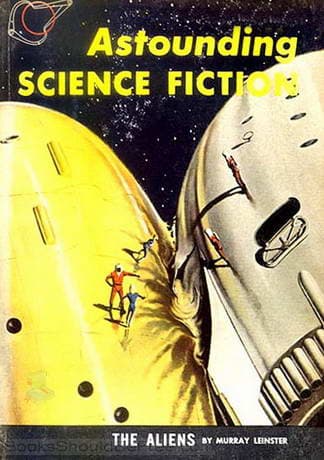
TL;DR: Worth your commute — if your commute is short. Murray Leinster's "Aliens" is a tight little golden-age sci-fi thought experiment about first contact that you can knock out in a single ride. It's the kind of story that would absolutely be a single episode of a prestige sci-fi anthology series today. Not a waste of time, but also not going to change your life.
The Premise Is Basically Game Theory But With Spaceships
Here's the setup: humanity is expanding across the galaxy. Another alien civilization is doing the same thing. They're going to meet. And Leinster, writing this in 1959, basically asks: what happens when two rational actors encounter each other with zero trust and no communication channel?
If you've ever studied the Prisoner's Dilemma or spent any time thinking about distributed systems where nodes can't trust each other — hi, that's literally my day job — this story hits different. The humans and aliens are both terrified that the other side will follow them home and wipe them out. So nobody can let the other side leave with navigational data. But nobody wants to fire first either. It's a deadlock. A race condition where the loser gets extinction.
Leinster doesn't pad this out with 400 pages of worldbuilding or romantic subplots. He just... presents the problem and works through it. At 1 hour 21 minutes, the ROI on this audiobook is actually pretty solid — you get a clean, complete idea executed without bloat. Could it have been a blog post? Maybe. But it would've been a really good blog post.
Tabitha Does Fine But Won't Make You Forget Ray Porter
Look, I'll be honest — the research I found on this narrator is thin. The credit says "Tabithat" which I'm pretty sure is a typo for Tabitha, and that already tells you something about the production polish here. This isn't an Audible Studios release with a budget. It reads like a public domain recording (Leinster's work is in the public domain), and the production values match that expectation.
Tabitha's narration is competent. Clear voice, steady pacing. She handles the military-adjacent dialogue and the technical descriptions without stumbling, which matters because Leinster gets into specifics about the ships and their detection systems. But here's the thing — this story doesn't really have distinct characters that demand vocal range. It's mostly one guy thinking through a problem, with some dialogue peppered in. So the narration doesn't get tested much. It's like reviewing a driver who only drove on a straight highway. Fine? Sure. But I can't tell you how she handles curves.
One thing that did bug me: the pacing felt a touch rushed in the middle section where the actual tension should be building — where both ships are sitting there, pointed at each other, trying to figure out if the other side is about to shoot. That section needed more breath, more space. At 1.5x (my default), it almost blurred past. I actually slowed down to 1.25x for the back half, which I almost never do.
Who This Is For (And Who Should Keep Scrolling)
Perfect for: train, gym. Skip for: deep work (too short to justify the context switch, honestly).
If you're a golden-age sci-fi completionist, this is essential Leinster. The guy basically invented the concept of first contact stories as we know them, and this is one of his cleanest examples. If you loved the logic-puzzle tension in "The Dark Forest" by Liu Cixin — where civilizations can't trust each other because the stakes are literally existential — Leinster got there 50 years earlier in a fraction of the page count. It's not as complex or as devastating, but the DNA is unmistakable. On that note — I reviewed Dark Tower V: Wolves of the Calla a while back, and King does the opposite: buries a tight premise under so much character texture that you almost forget there's a ticking clock underneath it all.
If you need character development, emotional arcs, or any reason to care about the humans as people rather than as game-theory participants... skip this. The characters are functions, not objects. They exist to execute the plot.
And if you're an audiobook credit person — do NOT spend a credit on this. It's 81 minutes. That's borrow-or-stream territory. Check your library app first.
The Shortest Distance Between Two First Contacts
I finished this before my train hit Palo Alto. Walked into sprint planning actually thinking about something interesting for once — whether Leinster's solution to his deadlock problem would hold up under modern game theory. (Kevin said I was "doing that thing again where I stare into space and mutter about Nash equilibria." Fair.)
It's a tiny, efficient little story. A microservice, not a monolith. Does one thing, does it cleanly, doesn't waste your cycles. For a foggy morning commute where your brain isn't ready for anything heavy? Pretty much exactly right.