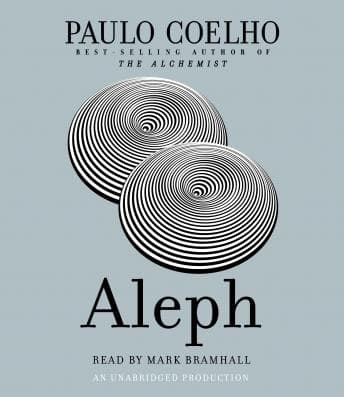

Paulo Coelho wrote himself as the main character of a novel about past lives, mystical time-space convergence points, and a twenty-something Turkish violinist he loved five hundred years ago. Let that sentence sit with you for a second.
I picked this up during a late-night coding session where my thesis code was throwing errors I genuinely couldn't explain, and I figured hey, maybe the universe is telling me to stop fighting procedural generation algorithms and start vibing with some spiritual fiction. Coelho's The Alchemist hit me hard in high school - the kind of book that made me want to wander the desert and find my Personal Legend (I ended up at Georgia Tech instead, which is basically a desert of deadlines). So Aleph seemed like the right kind of palate cleanser between Sanderson epics.
It is... not that.
When Your Self-Insert Character Has Plot Armor Made of Mysticism
Here's the thing about Aleph that's going to either hook you or lose you in the first hour: Paulo Coelho the author writes about Paulo Coelho the character going on a spiritual crisis journey, and the line between autobiography and fiction is so blurred it basically doesn't exist. He's a world-famous writer having a crisis of faith, and his spiritual master tells him to go touch some grass - literally, to travel and reconnect with the world. So he hops on the Trans-Siberian Railway, which is genuinely cool as a setting, and that's where things get weird.
He meets Hilal, this young violinist who basically forces her way onto the train, and Coelho - the character, the author, the whole thing - discovers that they share a connection from a past life during the Spanish Inquisition. There's this mystical space called the Aleph where past and present collapse into each other, and their scenes inside it are the most interesting parts of the book. The concept of two people standing in a specific physical point where all of time converges? That's got some real D&D planar magic energy to it. My D&D group would love this as a campaign mechanic, honestly.
But the novel keeps stepping on its own moments. Coelho will build toward something genuinely affecting - the weight of guilt carried across lifetimes, the idea that you can't move forward without forgiving yourself for ancient betrayals - and then he'll drop in a passage that reads like a motivational Instagram post from 2014. The karmic guilt threading through this book actually reminded me of how the Gospel of Matthew: Audio Course & Free Study Guide handles inherited moral weight - that sense that ancient wrongs echo forward through time lands a lot harder when the source material isn't also trying to be a self-help brand. "Close your eyes and try to discover what makes you happy." My guy. I'm trying to be moved here.
Mark Bramhall and the Art of Making Philosophy Sound Like It Matters
Mark Bramhall's narration is the best argument for listening to this rather than reading it. He's got this deep, steady voice that treats Coelho's more abstract passages with real weight - the kind of delivery that makes you stop and actually consider whether reincarnation guilt is a thing you should worry about at 2 AM. (I decided no, but I thought about it.) His tone has this honest, almost confessional quality that fits perfectly because the whole book reads like Coelho is telling you something he's slightly embarrassed about but needs to say anyway.
Where it gets tricky is character differentiation. This is essentially a book about one man's interior life with a handful of other people orbiting him, and Bramhall doesn't do much to distinguish between them vocally. Hilal should feel electric and disruptive - she's described as this intense force of nature who upends Paulo's careful spiritual journey - but in the audio she kind of sounds like everyone else. For a narrator with Audie Awards on his shelf, it's not his strongest showing. His philosophical monologue voice? Excellent. His ensemble cast voice? Pretty much absent.
At 8 hours and 30 minutes, the pacing is manageable, but there are stretches through central Asia where the train is moving faster than the plot. I caught myself drifting back to my code a few times, which is not ideal when the text is this contemplative. This demands your attention or it gives you nothing.
Who Gets on This Train (And Who Should Stay at the Station)
If you loved The Alchemist and you want more of Coelho's spiritual-journey energy but with a more personal, almost uncomfortably autobiographical bent, this will work for you. If you're into past-life narratives and the idea of karmic debt carried across centuries, the Aleph concept itself is genuinely fascinating. And if you can tolerate - or actively enjoy - a protagonist who is basically the author writing about how spiritually important the author is, you'll be fine.
But if you're coming from epic fantasy or hard worldbuilding, this is going to feel like drinking warm water when you wanted coffee. The magic system here - if you can even call it that - has zero rules, zero costs, zero Sanderson-level rigor. Things happen because they're mystically supposed to happen. And the Coelho-as-protagonist thing does get a little... much. There's a moment where he basically implies he was significant in multiple historical periods, and I actually said "okay, man" out loud in my apartment.
Rolling a Wisdom Check and Getting a 12
I read this instead of writing my thesis, and I'm honestly not sure either activity moved me forward. Aleph has real moments of beauty buried under layers of self-regard. The Trans-Siberian setting is underused. The past-life guilt concept is the best idea in the book and deserved a tighter, braver exploration. Bramhall does his best to anchor it, and his voice carries the weaker passages better than they deserve. But I kept wanting this to be the book it almost was instead of the book it is.
Coelho is either brilliant or frustrating, and in Aleph, he's both in alternating chapters.