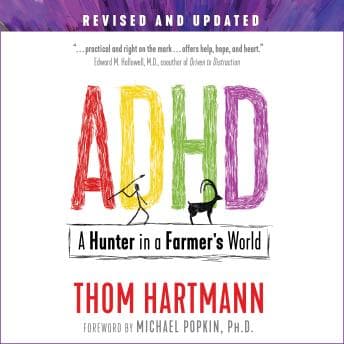

My one complaint upfront: this book is almost 8 hours long and the core thesis fits on a Post-it note. Hunters vs. farmers. ADHD brains evolved for scanning, impulsivity, and high-stimulation environments. Structured schools and open-plan offices are basically hostile environments for them. Done. You could've told me that in a podcast. But here's the thing - Hartmann earns his runtime in ways I didn't expect, so let me walk that back slightly.
I listened to this on a Saturday morning while my dad and I were doing nothing in particular at my parents' house in Koreatown - him watching Korean news, me with earbuds in pretending to be productive. It was weirdly appropriate. My parents ran that dry cleaning business on pure hunter instincts: constant environmental scanning (who's coming in, what's the competition doing, where's the next opportunity), impulsive pivots when something wasn't working, and an almost maniacal focus when a goal was in sight. They never would've survived a corporate performance review cycle. They were built for the hunt, not the harvest.
That's what Hartmann gets right that most self-help books miss entirely.
The Metaphor That Actually Works
Look, I've seen a lot of business frameworks get slapped onto human behavior and fall apart under five minutes of real-world scrutiny. The hunter/farmer framework holds. It's not perfect - Hartmann leans hard on the evolutionary speculation in ways that would make an anthropologist nervous - but as a functional mental model for understanding why certain people thrive in chaos and collapse in cubicles, it's genuinely useful. That same kind of reframing—taking a perceived weakness and turning it into a functional lens—is what I appreciated in How to Think Like a Roman Emperor.
The Benjamin Franklin, Thomas Edison, Andrew Carnegie examples are the kind of historical pattern-matching that makes for good storytelling but thin evidence. I've seen this move in a dozen business books. "Famous successful person was probably ADHD, therefore ADHD is secretly a superpower" is doing a lot of heavy lifting on not a lot of data. But Hartmann is self-aware enough that it doesn't feel like pure cheerleading. He acknowledges the real costs. The failed relationships, the abandoned projects, the financial impulsivity. He's not writing a "your disorder is actually a gift" Instagram caption. He's writing a survival guide.
The concrete strategies for parents, teachers, and managers are where this earns its runtime. Specific stuff: how to restructure tasks to work with attention cycles instead of against them, how to reframe classroom environments, how to identify which work contexts will let a hunter thrive vs. slowly destroy them. This is what my parents did instinctively. Now it has a TED talk. But the practical application sections are genuinely good, and I found myself pausing (at 2.0x, still) to actually think through the frameworks.
The Drug Conversation Problem
Hartmann is clearly skeptical of pharmaceutical solutions. He's not anti-medication in a tinfoil-hat way, but he consistently steers toward behavioral and environmental interventions first. Some listeners are going to find this frustrating, especially parents of kids who've seen real relief from medication. Fair complaint. He's not a physician, and the book occasionally reads like it's trying to avoid that lane while still commenting on it. If you're looking for a balanced clinical perspective on treatment options, this isn't it.
But if you're looking for a framework that helps you stop pathologizing a brain type that's just... different? That's here. And it's delivered without the condescension that usually shows up when neurotypical authors write about neurodivergence.
Robin Douglas and the 7h 52m Question
Robin Douglas is competent and unobtrusive. No weird pacing issues, no mispronunciations that yanked me out of the material, no character-voice theatrics (it's non-fiction, so that's appropriate). He reads like a smart person explaining something, which is exactly what you want. Nothing that made me reach for the speed controls beyond my default 2.0x. Nothing that made me wish for the author's voice instead. Solid, functional narration that serves the material without getting in its way.
The 7h 52m runtime is the real issue. The key takeaway is worth the listen. The other 5 hours? Mostly reinforcement and case studies. If you're in the ADHD community - parent, teacher, person who's spent 30 years wondering why they can't just sit still in meetings - the runtime justifies itself because you're probably going to find multiple sections that feel personally relevant. If you're a manager trying to understand a team member, skip to the workplace sections. You'll get 80% of the value in half the time.
Who Actually Needs This
Adults who've recently been diagnosed and are still in the "what does this even mean" phase. Parents who've been handed a diagnosis and a prescription and not much else. Managers who have a high-performer who's also a chaos agent and can't figure out how to work with them instead of around them.
If you're a skeptic looking for clinical rigor, look elsewhere. If you're someone who's spent their whole life being told they're broken and you want a framework that reframes that without being saccharine about it - this is your book.
Bottom line: Hartmann built something genuinely useful here, padded with more historical anecdote than it needed. The hunter/farmer lens is a mental model worth having. My parents lived it without the vocabulary. Maybe that's the point.