
Okay. I need to rant for a second.
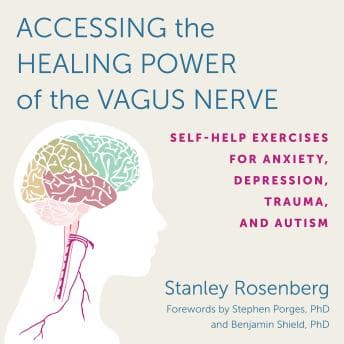
I am so tired of self-help books that throw around neuroscience terminology like confetti at a parade and then tell you to "just breathe deeply." You know the ones. They name-drop the amygdala, mention fight-or-flight, maybe toss in a reference to neuroplasticity, and then offer advice your grandmother could've given you for free. Becoming Supernatural is a prime offender in that category — Dispenza name-drops quantum fields and heart coherence with genuine enthusiasm, and I respect the ambition, but my clinical brain kept asking where the controls were. So when I picked up Stanley Rosenberg's Accessing the Healing Power of the Vagus Nerve, I was fully prepared to be annoyed.
I was not prepared to spend a Saturday afternoon in my kitchen, hands covered in turmeric from a dal that was definitely overcooking, genuinely fascinated by the anatomy of cranial nerves.
The Part Where a Body Therapist Schools Psychology Researchers
Here's what's interesting about Rosenberg. He's not a neuroscientist. He's not even primarily an academic - he's a craniosacral therapist and Rolfer with thirty-plus years of clinical experience who also trained actors at Yale and Brandeis in yoga and movement. And somehow, he's written one of the most accessible explanations of Stephen Porges's Polyvagal Theory I've encountered. The research actually shows that Polyvagal Theory has been notoriously difficult to translate into practical application - most texts on it read like they were written for an audience of five very specific professors. Rosenberg's "each-one-teach-one" philosophy means he genuinely wants you to understand this stuff, not just nod along.
The book's core argument is that most of us are walking around with dysfunctional autonomic nervous systems - stuck in sympathetic (fight-or-flight) or dorsal vagal (shutdown/freeze) states - and that you can actually test for this and fix it with specific physical exercises. Not "visualize a calm lake" exercises. Actual hands-on-your-head, move-your-eyes-this-way, hold-for-thirty-seconds exercises. Rosenberg breaks the vagus nerve into its ventral and dorsal branches and explains why this distinction matters for everything from social anxiety to digestive problems. I found myself asking: why does mainstream psychology still teach the autonomic nervous system as a simple two-part on/off switch when Porges published his theory in the 1990s? That's a genuinely uncomfortable question for my field.
The case studies from his clinical practice are where this gets real. He describes working with patients whose chronic conditions - migraines, shoulder pain, emotional flatness - shifted after targeted vagal exercises. Now, the researcher in me wants to pump the brakes here. These are clinical anecdotes, not randomized controlled trials. But Rosenberg doesn't pretend otherwise. He's honest about what he's observed versus what's been formally studied, and that intellectual honesty actually made me trust him more.
The Audiobook Problem Nobody Warned Me About
Here's where we hit a wall. This book is full of physical exercises. Step-by-step, "put your hands here, turn your head there, hold this position" instructions. In print, there are presumably diagrams. In audio format, narrated by Derek Botten? You're listening to someone describe body positions you can't see.
Botten reads with a steady, clear, informational tone - perfectly fine for the theoretical chapters. He's not doing anything wrong, exactly. But he's also not doing anything to compensate for the fact that you're essentially listening to someone read IKEA assembly instructions without the pictures. The exercise sections become a memory game. I had to pause, rewind, try to position my hands, realize I'd misunderstood the head tilt direction, rewind again. Psychologically, this doesn't track as a good audiobook experience for a book whose entire selling point is hands-on practice.
The theoretical first half - Polyvagal Theory overview, the five-state model, the neuroanatomy - actually works beautifully in audio. Nearly nine hours means Rosenberg takes his time building the conceptual framework, and having it narrated at a steady pace helped it sink in during my morning jogs through Cambridge. But the practical second half? You really need the print version alongside it. This isn't Botten's fault. It's a format mismatch.
Who This Is Actually For (And Who Should Run)
If you're a therapist, bodyworker, or trauma-informed practitioner, the theoretical framework alone is worth the listen. Rosenberg connects vagal function to social engagement behaviors in a way that gave me genuine insight into why some therapy clients can't make eye contact or why their voices go monotone under stress - it's not just "anxiety," it's a measurable cranial nerve dysfunction. That reframe is powerful.
If you're someone struggling with chronic stress or trauma responses and you want practical exercises, get the print book. Seriously. The audiobook will give you the why but fight you on the how.
If you need rigorous empirical evidence before you'll try anything, this will frustrate you. Rosenberg leans heavily on Porges's framework and his own clinical observations. The science is real but the evidence base for these specific exercises is still building.
My Therapist Would Probably Assign This One
I'm giving this a qualified recommendation. The content is genuinely valuable - Rosenberg understands human physiology in a way that bridges the gap between body-based and talk-based therapeutic approaches, and his generosity with knowledge (he literally wants you to teach these exercises to other people) is refreshing in a field full of proprietary certifications and gatekeeping. But the audio format undercuts the book's greatest strength: its practical exercises. Listen for the theory. Buy the paperback for the practice. And maybe don't try the basic exercise while your dal burns. Learned that one the hard way.