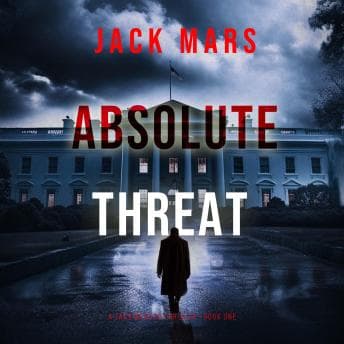

What happens when you take a premise with real potential — former Marine sniper turned Secret Service agent protecting the President — and hand it off to an AI voice that literally reads out "asterisk asterisk asterisk" during scene breaks?
You get Absolute Threat. And I'm not talking about the militia in the plot.
The Briefing Sounded Good on Paper
Look, I wanted to like this one. Jake Mercer's background checks a lot of boxes that appeal to me personally — the sniper-to-Secret-Service pipeline isn't the most common career path, but it's not fantasy either. I've known guys who made similar transitions from special operations into protective details. The setup of a domestic militia targeting the President while Mercer wrestles with a shadow from his own past? That's a solid framework for a political thriller. Brad Taylor and Vince Flynn comparisons are right there on the marketing copy, and I get why they made them.
I found the same kind of special-ops authenticity I was hoping for here in The Ex, which actually earns its thriller credentials.But here's where it fell apart for me: the writing itself has the depth of a mission brief someone wrote at 0300 after their fourth Monster energy drink. Side characters show up, deliver their function, and evaporate. The political angle tries to gesture at something meaningful about domestic extremism — a topic that deserves serious treatment — and ends up saying nothing at all. I've sat through actual Pentagon briefings with more dramatic tension.
The militia threat never feels genuinely dangerous because the book doesn't earn it. There's no escalation, no moment where I thought, "Oh, they're actually three steps ahead." Everything unfolds with the predictability of a training exercise where the OPFOR follows the script.
Jack Mars pulls off a much tighter version of the domestic-threat-to-the-President setup in Any Means Necessary, and unlike this one, the pacing actually kept me up past my rack time."Hades" Is Not a Codename I'd Trust
Let me cut to the chase on the narration: it's bad. Not "eh, the narrator's a little flat" bad. We're talking about a synthesized AI voice that reads punctuation marks out loud. Scene breaks marked by asterisks? The voice just says "asterisk asterisk asterisk." I was driving back from a client site in San Marcos when that happened the first time, and I honestly thought my phone was glitching. Nope. It kept happening.
The emotional range of this "Hades" synthesized voice runs from monotone to... slightly different monotone. No character differentiation that I could detect. A tense standoff between Mercer and a militia leader sounds exactly like a quiet conversation with his wife. Zero shift in pace, zero shift in intensity. I've heard more vocal variation from an automated gate access system at a forward operating base.
I get that AI narration is cheaper. I understand the economics. But if you're going to use synthetic voice, at least program it to handle basic formatting elements without reading them aloud like a confused text-to-speech demo from 2008.
When the Mission Parameters Don't Add Up
Here's what really gets me — and this is where my background makes me twitchy. The book bills itself as a political thriller with military credibility. Mercer's supposed to be a Marine sniper. But the writing doesn't demonstrate the kind of operational knowledge that would make me believe the author spent any serious time researching how protective details actually work, or how a sniper thinks. The tactical moments feel generic. Lifted from other thrillers rather than built from the ground up.
At five hours, it's a short listen. Normally I'd say that's a plus — get in, get the story, get out. But in this case, five hours felt like it should've been two, because there just isn't enough substance to justify even that runtime. I bumped it to 1.5x (my usual 1.25x wasn't enough) and still felt like I was waiting for something to happen that never quite did.
I will say this: the core concept of the series has legs. A Secret Service thriller series with a protagonist who has real combat experience could absolutely work. But the execution here — both on the page and in the audio booth (or whatever server room this voice was generated in) — doesn't come close to delivering on that promise.
Who Should Gear Up and Who Should Stand Down
If you're a completist who needs to start every series at Book 1 regardless of quality, and you have a streaming subscription where this costs you nothing extra, maybe. But if you're spending a credit on this? Don't. If you want the Marine-turned-protector angle done right, go pick up a Vince Flynn Mitch Rapp book instead. If you want AI narration that's actually tolerable... well, I haven't found that yet either, but it's not here.
Ranger walked out of the room during chapter three. Dog's got better tactical judgment than I gave him credit for.
Mission Failed — Reassign Assets
Worth your time? Here's the debrief: a decent premise buried under thin writing and the worst AI narration I've encountered in audiobook form. The synthesized voice reading out literal punctuation marks isn't a minor production issue — it's a fundamental failure in quality control. I've seen this scenario play out in real life: good concept, terrible execution, and nobody in the chain of command stopped to ask if this was actually ready for deployment. It wasn't.