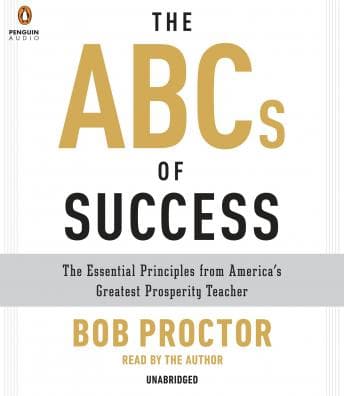

Everyone and their LinkedIn connection seems to swear by Bob Proctor. The Secret featured him. Tony Robbins-adjacent circles worship him. So when I finally queued up The ABCs of Success during a late-night cooking session — paneer tikka masala, if you're curious, the kind that takes three hours because I refuse to use shortcuts — I expected to feel something. Inspiration, maybe. A cognitive shift. At minimum, the dopamine hit of a well-constructed argument.
What I got was... more complicated than that.
Sixty-Seven Essays and the Ghost of Napoleon Hill
Here's the structure: A-to-Z topics, each getting a brief essay treatment. Achievement. Belief. Confidence. You get the pattern. It's essentially a motivational dictionary, and Proctor frames most of his insights through the lens of Earl Nightingale's mentorship and Napoleon Hill's Think and Grow Rich — a book he apparently reads every single day. (My therapist would have thoughts about that level of attachment to a single text, but I digress.)
The thing is, if you've read Hill, or Nightingale's The Strangest Secret, or Mandino, or Ziglar, you've already absorbed about seventy percent of what's here. The research actually shows that self-help literature tends to recycle a remarkably stable set of core principles — belief shapes reality, persistence beats talent, gratitude unlocks abundance — and Proctor is very much operating within that tradition. He's not innovating. He's curating. And whether that's a feature or a bug depends entirely on what you need from the book.
What I found myself asking: why does Proctor keep circling back to the same handful of principles under different alphabetical headings? "Persistence" and "Winning" and "Effectiveness" start blurring together after a while. The A-to-Z format creates an illusion of breadth, but psychologically, the underlying message is surprisingly narrow. Believe in yourself. Visualize outcomes. Take action. Repeat.
That's not wrong. It's just not sixty-seven essays' worth of distinct insight.
Proctor Reading Proctor — The Audio Experience
Now, here's where the audiobook format gets interesting. Bob Proctor narrates most of this himself, with Sandra Gallagher joining in. And Proctor's voice carries the authority of a man who has been saying these things to packed auditoriums for decades. There's a grandfatherly certainty to his delivery — unhurried, warm, absolutely convinced of every word leaving his mouth.
At four hours and thirty-seven minutes, this is a short listen. Bite-sized, even. And the essay format means you can dip in and out without losing a narrative thread, because there isn't one. That's both its accessibility and its limitation. I listened across three cooking sessions and a morning jog, and each entry felt self-contained enough to process independently. But I never felt pulled forward. Never thought, I need to hear what comes next. The A-to-Z structure removes any sense of building momentum.
Compared to, say, Stephen Covey's 7 Habits — which Proctor is frequently placed alongside — there's a notable absence of framework here. Covey gives you a system. Proctor gives you affirmations dressed in essay form. Compared to Mandino's The Greatest Salesman in the World, there's no narrative vehicle to make the principles sticky. This is a fascinating case study in how format choices shape retention. The research on learning actually shows that principles embedded in stories or systems get encoded more deeply than standalone declarations. Proctor's alphabetical approach is easy to consume but hard to remember.
The Belief Problem
Here's my honest psychological read. Proctor's framework rests heavily on the idea that your thoughts literally create your reality — the law of attraction stuff that The Secret popularized. And look, there's legitimate psychology supporting visualization and positive self-talk. Goal-setting research, self-efficacy theory, Bandura's work — it's real. But Proctor doesn't distinguish between "your mindset affects your behavior, which affects outcomes" and "the universe rearranges itself to match your vibration." Those are wildly different claims, and collapsing them together is where I start getting twitchy.
Psychologically, this doesn't track as a complete model of human success. It underweights structural barriers, luck, privilege, and the thousand external variables that shape outcomes. For someone already positioned with resources and access, "believe and persist" might be the missing ingredient. For someone without those things, it can start to feel like blame dressed up as empowerment.
But — and this is the part that keeps me from dismissing it — Proctor clearly helped a lot of people. The listener who called him "a great teacher and a great man" isn't wrong about the impact, even if I'd quibble with the mechanism. Sometimes the value of a book isn't in its accuracy but in its permission-giving. Permission to want more. Permission to act. The psychology of that permission-giving mechanism is something Katty Kay and Claire Shipman dig into with actual research in Confidence Code: The Science and Art of Self-Assurance--What Women Should Know — and they're far more honest about where belief alone hits its ceiling.
Who Gets the Most Out of This
If you're new to the self-help and prosperity thinking tradition, this is actually a decent entry point. Short, accessible, zero jargon. If you've already read Hill, Nightingale, Covey, and Mandino — you're going to feel like you're hearing covers of songs you already know. Pleasant covers. But covers.
Best consumed in small doses between tasks, not as a dedicated sit-down listen. At 1.25x speed, it flows well without losing Proctor's cadence.
My Prescription
I respect the man. I respect the tradition. But I can't pretend sixty-seven variations on "change your thinking, change your life" gave me anything I hadn't already encountered in the source material he's drawing from. If Proctor is your gateway, great — go read Think and Grow Rich next. If you've already been down that road, this will feel like a warm but familiar conversation you've had before.