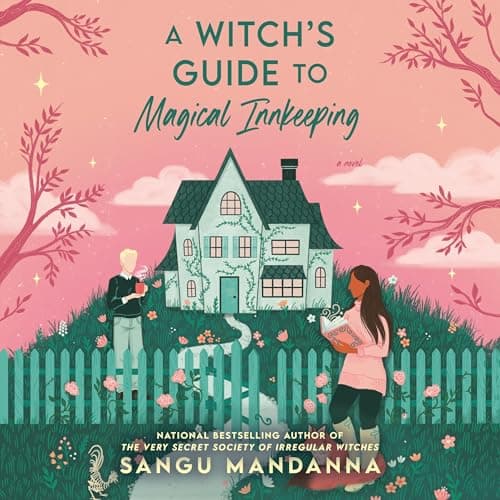

I was steeping a gallon of sweet tea for Sunday's fellowship hall when Luke Larsen came in out of the Lancashire dark. Icy, bookish, a magical historian with no interest in anybody's business. I said out loud to my empty kitchen, "Well, he'll be warm by the last chapter." The tea bags hadn't even finished. Some mysteries a reader is owed, and this was not one of them.
And then there's the fox. A semi-villainous talking fox who will not keep his opinions to himself. I spent the first hour thinking, Lord, do we need him too? An enchanted inn, a resurrected great-aunt, a meddling Guild, a parade of odd guests, and now a fox with commentary? It felt like a church supper where everybody brought a casserole and nobody brought a vegetable.
But I kept going. I carried the earbuds from the stove to the porch, and somewhere between the tea cooling and the sun dropping behind the peach trees, the book stopped feeling like clutter and started to feel like a household.
Sera Paid for Jasmine Before Page One
The bill comes due before the story opens. Sera Swan was one of the most powerful witches in Britain. Then her great-aunt Jasmine died, and Sera brought her back. That spell took most of her magic, and the Guild exiled her for it. By the time we meet her, she's running the inn with the very woman she saved and doing it grumpily.
I didn't trust that grumpiness at first. It read like a sitcom setup. But in Samara MacLaren's voice, Sera's sarcasm has a catch in it. When Sera talks about the future she lost, MacLaren pulls the snap out of her voice, and you hear a young woman who gave up her career for her family and is still doing the math on it. Then Jasmine comes in sounding warm and unbothered, the way old women do when they've been spared and know it, and you understand why Sera would make the same choice again.
So the cozy material has a reason to be there. Sera doesn't need the found family because it's charming. She needs it because the life she planned is gone. The old spell that might restore her power is the plot, but the real question is whether she can stop grieving long enough to see who's sitting at her table.
Now, I promised myself honesty about the prose, since that's my whole religion. Mandanna writes plain, quick, and kind. The jokes land and the feelings are legible. But at 0.85x I never rewound a sentence for its own music. I rewound for Jasmine, not for the craft. If you come to novels for language you can hold up to the light, this won't feed that hunger.
My one real complaint is the resurrection and the exile. Those are the most dramatic things that ever happen to Sera, and they're over before we arrive, so we mostly get them as backstory. I wanted to be in the room when the Guild cast her out. What we get instead is the long afterward. That's a legitimate choice, but it keeps the sharpest pain at arm's length.
A Scottish Reserve, Two Trolls, and No Cartoons
MacLaren is why I never touched the speed dial. She gives Luke a Scottish accent, and other listeners swooned over it too. It earns its place. His coldness comes out as caution rather than cruelty, so you hear the thaw coming in his vowels well before Sera notices. It's the same predictable thaw I griped about, but it's an awful lot nicer to listen to.
The troll siblings are the comic relief, and listeners keep naming their voices as a highlight. They're right. MacLaren lets them be ridiculous without turning them into cartoons. That restraint holds across the whole crowded house for 9h 53m. Even the fox stays mischievous and never gets shrill. I'll admit he grew on me.
I noticed no music and no sound effects. It's just one woman telling a story, which is how I like it. Her pauses held up at my slow speed. One listener went through at 1.4x and was happy too, so she's sturdy in both directions.
Who Ought to Pull Up a Rocker
This is a companion to The Very Secret Society of Irregular Witches, not a sequel. Both books follow a witch whose ordinary life is suddenly full of strangers who turn into family, with a romance running underneath. One reviewer couldn't choose between them. The difference is where they start. Very Secret Society is about a lonely woman letting people in. This one is about a woman who already has her people and has to make peace with what keeping them cost. If you loved the first, the second will ask a little more of your heart.
If what drew you was a house full of people healing from a loss, The House on Olive Street works that same ground without any magic: grief, friendship, and the slow business of rebuilding a household.
Skip it if you want real danger. The Guild hovers, but nobody here is truly frightening. Skip it if you can call a romance from its first scene and resent being right. And if a wisecracking talking fox makes your teeth hurt, he's around a lot.
It does sit well alongside your hands being busy. I'd put it on for folding laundry, an evening walk, or winding down after a long day. You won't lose the thread if you look up to stir the pot.
Before the Ice Melts in the Glass
I finished on the porch with the pitcher sweating beside me. I'd come in braced for a fox and a foregone romance, and I got both. I also got a young woman who traded her magic for her great-aunt's life and is still learning to live with that trade. That part was worth the casseroles.