
Look, I know what you're thinking. Tom Bradley reviewing a romantasy? Hear me out.
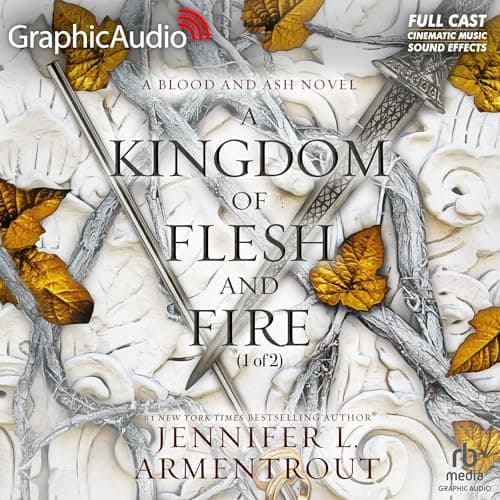
I was knee-deep in a failed procedural dungeon generation algorithm at 2 AM, my thesis document mocking me from one monitor while my code threw errors on the other. I needed something to fill the silence that wasn't another Sanderson reread, and my friend (okay, my D&D group's bard player who has extremely strong opinions about Casteel Da'Neer) had been pestering me about the Blood and Ash series for months. So I threw on the Graphic Audio dramatized adaptation of A Kingdom of Flesh and Fire and let it ride.
And honestly? The world-building scratched an itch I didn't expect.
Graphic Audio Turned This Into a D&D Session I Didn't Know I Needed
Here's the thing about dramatized adaptations - they either work or they're an absolute train wreck. This one mostly works. The full cast, sound effects, and cinematic score transform what is fundamentally a slow-burn romance with fantasy trappings into something that feels like you're sitting at a table while a really ambitious DM runs a campaign where two of the players keep flirting instead of fighting the encounter. The battle scenes hit differently when you've got actual steel-on-steel sound design and background chaos. There's a sequence where the wolven are closing in and the audio production layers growls under the dialogue - that kind of environmental detail is what justifies the dramatized format existing.
But let's talk about the elephant in the room. Whoever made the creative decision to give Casteel that unnaturally deep, almost digitally-processed voice? I need to have a conversation with them. It's supposed to convey "dangerous, sexy Dark Prince" and instead it lands somewhere between Darth Vader doing ASMR and a voice modulator from a true crime documentary. Every time he said something that was meant to be seductive, I was pulled right out of the scene. Katie Boothe as Poppy carries the emotional weight well - there's a brittleness in her delivery when Poppy's processing the betrayal from book one that genuinely lands. But Casteel's voice is a choice. A bold choice. A choice I respectfully disagree with.
And then there's the child voice. I don't know who needs to hear this, but that voice was nightmare fuel. Like "I'm-turning-on-the-lights-in-my-apartment-at-2-AM" nightmare fuel. My D&D group has fought liches less unsettling than that vocal performance.
The Magic System Is... Wait, Is There a Magic System?
Okay so this is where the Sanderson brain in me had to recalibrate. Armentrout isn't building a hard magic system with rules and limitations you can diagram on a whiteboard. Poppy's abilities - the pain sensing, the emotional reading, the growing powers she doesn't understand - operate more on vibes than mechanics. And you know what? In this context, it kind of works. The mystery of what Poppy is drives the plot forward in a way that a detailed Allomancy chart wouldn't serve. Her powers escalate in ways that feel earned emotionally even if they're not precisely defined. When the earth starts shaking and the skies bleed at the end of this part one, the lack of explanation is actually effective because Poppy herself doesn't understand it.
The political world-building between the two kingdoms - the Ascended versus Atlantia, the propaganda Poppy was raised on versus the reality she's discovering - that's genuinely interesting. Burn for Me does something similar with its faction politics - two sides who both think they're the good guys, and a protagonist caught in the middle trying to figure out which version of reality to believe. It's not Sanderson-level world-building, but the moral ambiguity of both sides gave me something to chew on between the (many) scenes of Poppy and Casteel verbally sparring slash flirting. The banter between them is the engine of this book, and if you're not invested in their dynamic, you're going to have a rough nine hours.
The Carriage Scene Problem
I have to mention this because it's been living in my head. There is a scene. In a carriage. Next to a dead body. And the energy of that scene is... not what you'd expect given the proximity to a corpse. It's the kind of tonal whiplash that would get a player kicked from a serious D&D table. I genuinely paused my code, took off my headphones, and stared at my wall for a minute. Armentrout commits to her character dynamics with zero regard for situational appropriateness and I can't decide if that's bold or bananas.
This part one ends on a cliffhanger that's genuinely wild - the kind of ending that makes you understand why they split it into two parts (and also why that's slightly evil from a pricing standpoint). I immediately queued up part two, thesis be damned.
Roll for Initiative (Or Don't)
If you love immersive audio drama and want your romantasy with full production value, this delivers in ways a standard single-narrator audiobook can't. The sound design during action sequences is legitimately great. But you need to accept that Casteel's voice is going to sound like he's narrating from inside a well, and there's a child voice that will haunt your dreams.
If you need your fantasy with hard magic systems, detailed maps, and minimal romance - this isn't your campaign. Same goes if you can't handle spicy content or you mostly listen while distracted. The layered audio production demands actual attention.
I read - listened to - this instead of writing my thesis. Dr. Patel would be disappointed but not surprised.