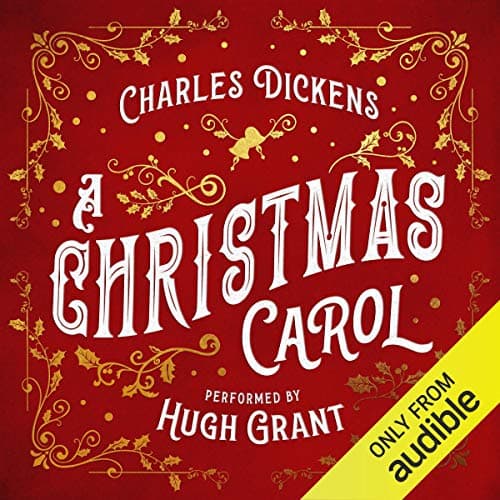

Can a story you've heard a hundred times still surprise you? I genuinely wasn't sure when I queued up yet another version of A Christmas Carol — a novella that's been adapted, parodied, and referenced so relentlessly that its plot beats feel embedded in cultural DNA. Scrooge is grumpy, ghosts show up, redemption happens, tiny Tim blesses us every one. What could possibly feel fresh here?
Hugh Grant, apparently.
I started this on a gray December afternoon, half-expecting pleasant background listening while wrapping gifts. Within ten minutes, the wrapping paper was abandoned and I was sitting on the couch just... listening. Grant's narration has an intimacy that caught me off guard. He reads Dickens the way a brilliant friend might tell you a story over a glass of something warm — confident, witty, and genuinely invested in what happens next. His British RP delivery suits Dickens' prose like it was written for him (which, in a sense, it was — Dickens was performing this material for Victorian audiences in exactly this register).
What Grant does exceptionally well is channel Dickens' authorial voice. There are passages in A Christmas Carol where Dickens addresses the reader directly, breaking the fourth wall with sardonic asides and philosophical observations about human nature. In many adaptations, these sections get cut. Here, they're the highlight. Grant delivers them with the perfect balance of dry humor and genuine feeling, and you remember that Dickens wasn't just a storyteller — he was a performer who understood comic timing. That same quality — a narrator who clearly understands the material as performance rather than just text — is something I noticed in my time with The Correspondent, where the voice work carries a similar sense of genuine investment.
The character work is worth discussing honestly. Grant doesn't do wildly distinct voices. You won't get a gravelly Marley, a squeaky Mrs. Cratchit, or a booming Ghost of Christmas Present. Instead, he uses subtle shifts in tone, tempo, and emotional register to signal who's speaking. Scrooge's lines carry a clipped impatience that gradually softens. Bob Cratchit has a gentle earnestness. The ghosts each get their own emotional temperature. It works beautifully for a text this short — at under three hours, you're never confused about who's talking, and the restraint keeps the focus on Dickens' language rather than turning the performance into a one-man show.
If you specifically want a full theatrical experience with wildly differentiated character voices, though, this isn't that production. Some listeners might find the subtlety too uniform. I'd argue it's a deliberate artistic choice that serves the material, but your mileage may vary depending on what you want from a narrator.
The emotional delivery during Scrooge's visitations from the spirits is where Grant earns his keep. The Ghost of Christmas Past sequences require the narrator to shift between wonder, regret, and grief within a few paragraphs, and Grant handles these transitions with real skill. There's a warmth in his voice during the Fezziwig scenes that dims noticeably when young Scrooge loses Belle, and it doesn't feel performed — it feels felt. The Ghost of Christmas Yet to Come section carries genuine weight, and Grant wisely pulls back here, letting Dickens' spare, dark prose do the heavy lifting while his voice goes quiet and serious.
At 2 hours and 44 minutes, this is a perfect single-sitting listen. I'd recommend dedicated listening rather than background play — the prose is rich and rewards attention, and Grant's subtler vocal choices can get lost if you're only half-engaged. It's an ideal Christmas Eve listen, or honestly, a good companion for any winter evening when you want something that reminds you why this story has endured for nearly two centuries.
The production from Audible Studios is clean and unadorned — no music, no sound effects, just Grant and the text. This is the right call. The story doesn't need atmosphere manufactured around it; Dickens built all the atmosphere you need into the words themselves, and Grant trusts that.
I came into this slightly skeptical. Celebrity narrators are hit-or-miss, and there are dozens of A Christmas Carol recordings competing for your attention. But Grant's version has something special: it makes the familiar feel personal again. When Scrooge wakes on Christmas morning, giddy and transformed, Grant's voice carries an infectious joy that made me smile despite knowing exactly what was coming. That's the mark of great narration — not just reading words well, but making you feel them as if for the first time.
One listener described it as being "wrapped in a warm blanket," and that's honestly the most accurate description I can offer. This is comfort listening at its finest, elevated by a narrator who clearly respects and enjoys the source material. Listen if you want a warm, intimate reading that trusts Dickens' prose and lets it breathe. Skip if you're after a full-cast theatrical production or dramatically distinct character voices — Grant's approach is subtle, and that subtlety is either the whole appeal or the one thing that'll leave you wanting more.