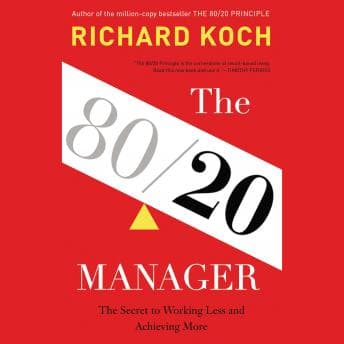

"The 80% of managers who fail do so because they focus on 80% of the wrong things." Koch drops that line somewhere in the first hour, and I had to rewind it - which, at 2.0x, is a commitment I don't make lightly.
I was on a Saturday morning walk, the kind Jenny insists I take because apparently staring at a laptop for six hours straight isn't "restorative." She's not wrong. And honestly, Koch's premise hit differently with some actual physical distance from my inbox: most of what you do at work doesn't matter. Most of what fills your calendar is noise. You already know which 20% of your clients, decisions, and relationships generate 80% of your real results. You just refuse to act on it.
That's the book. That's the whole book.
The Part That Earns Its Runtime
Here's what Koch gets right that most productivity gurus completely fumble: he doesn't pretend this is about working smarter in the margins. He's arguing for a fundamental restructuring of how you think about your role as a manager. Stop being a traffic cop for other people's priorities. Become a sniper for your own.
The section on what he calls "lazy managers" - executives who appear to do very little but deliver outsized results because they've ruthlessly identified the one or two levers that actually move the business - that's the 45 minutes worth listening to. I've watched this play out at McKinsey. The partners who billed the most hours were rarely the ones who built the most durable client relationships. The ones who seemed almost suspiciously calm? They'd figured out Koch's principle before Koch wrote it down.
This is what my parents did instinctively. My dad spent 14 hours a day at the dry cleaning shop, but the two hours he spent on his best wholesale accounts and his three highest-volume walk-ins? That was the business. Everything else was keeping the lights on. Now it has a TED talk.
The Part That Doesn't
Here's my honest audit: Koch's original 80/20 Principle book did this better. That book had genuine intellectual weight - Pareto distributions, historical examples, the kind of empirical grounding that makes you feel like you're learning something structural rather than being coached. This one leans harder on anecdote and repetition. By hour four, you've heard the core insight repackaged about six different ways for six different management contexts. The insight doesn't get stronger with repetition. It just gets longer.
I've seen this fail at three different companies - the "apply one principle to everything" book that runs out of principle around chapter eight and starts padding. The Little Book of Trading has the same structural problem - one genuinely useful idea stretched past its natural lifespan. Koch isn't egregious about it, but he's not innocent either.
And then there's Roger Davis. The narration is... a situation. Most of it is competent - his American accent work when quoting figures like Walt Disney is surprisingly clean. But whoever approved his pronunciation of "success" as something that sounds disturbingly close to "sucks" apparently didn't do a final pass. At 2.0x speed, it hits you like a small car accident every single time. "Sucks-ful managers." "The path to sucks." I started counting. I stopped at eleven because it was affecting my blood pressure.
My 2.0x speed couldn't save this one from that particular audio landmine.
The ROI Calculation
Seven hours. The core insight is real and worth absorbing if you haven't read the original 80/20 Principle. The lazy manager framework is genuinely useful - I've already applied it to how I structure my consulting engagements, specifically cutting two client check-ins per week that were pure theater and zero signal.
But the book itself doesn't respect the principle it preaches. A truly 80/20 book about 80/20 management would be 90 minutes. Koch needed an editor who'd read his own work.
Skip to chapter 5. Thank me later. And maybe listen at 1.5x so the "sucks" situation is slightly less jarring.