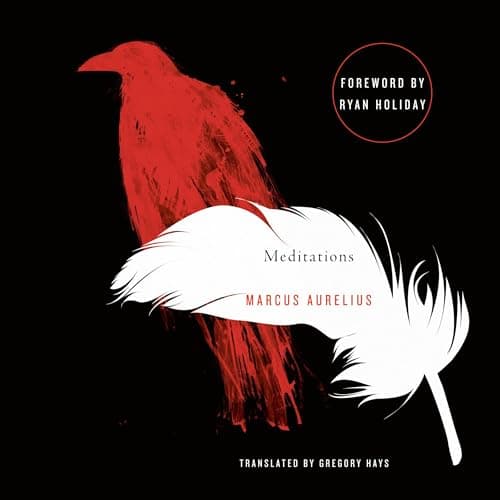

Everyone tells you Meditations will change your life. Stoic Twitter won't shut up about it. Ryan Holiday has built an empire on it. Your favorite CEO quotes it in interviews. So when I finally sat down with this audiobook version — the Gregory Hays translation with Holiday's new foreword — I expected to feel enlightened. What I actually felt, at least initially, was irritated.
Let me explain. The Hays translation itself is genuinely excellent. Where older translations of Marcus Aurelius read like Victorian furniture catalogs — ornate, heavy, gathering dust — Hays strips everything back to bare wood. "Your ability to control your thoughts — treat it with respect." That's clean. That's direct. That's a Roman emperor talking to himself in a military camp nearly two thousand years ago, and it hits like something you'd scribble in your own journal at 2 a.m. The translation earned its reputation.
The problem is Roger Davis.
Now, before the pitchforks come out, Davis is technically proficient. His pacing is measured, his enunciation is precise, and every word lands clearly. But "clearly" and "compellingly" aren't the same thing. His delivery carries a stiff, aristocratic British tone — think someone reading royal decrees at a Renaissance fair — and it creates an odd disconnect with Hays's deliberately modern, stripped-down prose. You've got a translation designed to feel immediate and intimate, filtered through a voice that sounds formal and remote. It's like watching a casual conversation performed as a Shakespearean monologue.
Some listeners will find this accent atmospheric, even appropriate for an emperor's private writings. Fair enough. But the flatness is harder to defend. Meditations isn't a novel with plot twists to keep you hooked — it's a collection of philosophical reflections, many of them only a sentence or two long. Without vocal variety or emotional texture in the narration, stretches of the audiobook blur together. I caught myself rewinding more than once during a morning commute, realizing I'd absorbed nothing for the past several minutes.
Ryan Holiday's foreword and contributions, narrated by Holiday himself, provide a welcome contrast. His sections are warmer and more conversational, offering context that helps anchor Marcus's sometimes cryptic entries. If you're new to Stoicism, these framing pieces are genuinely useful. They don't overstay their welcome. That same accessible, "here's-why-this-ancient-stuff-actually-matters" energy is something Dan Harris nails in 10% Happier — and his audiobook narration is a clinic in keeping philosophical content from glazing you over on the morning commute.
But here's the thing — and this is where I have to be honest about the book itself versus the audiobook format. Meditations was never meant to be consumed linearly. Marcus wrote these entries for himself, not for an audience, and certainly not for someone listening straight through on a four-hour drive. The book works best when you pick it up, read a passage, sit with it, and put it down. In print, you can do that naturally. In audio form, you're locked into a continuous stream of philosophical observations, and without a narrator who can make each one land with fresh energy, fatigue sets in fast.
Compared to something like Letters from a Stoic — where Seneca's letter format gives you natural pauses and narrative variety — Meditations in audio form feels relentless in its compression. And compared to the more accessible Stoic audiobooks like The Obstacle Is the Way, where Holiday himself provides narrative structure and storytelling, this is a much more demanding listen.
The content, though, remains extraordinary. Marcus on grief: brief and unsentimental. Marcus on ambition: cutting. Marcus on death: startlingly calm. There are passages here that will stop you cold, lines you'll want to replay and memorize. Book Two's reflections on mortality hit different when you know he likely wrote them during a plague. The bite-size format means you're never more than a minute away from something worth hearing.
At under five hours, it's a quick listen, but I'd actually recommend slowing down rather than speeding through. Treat it like a daily meditation — one chapter per sitting, maybe during a quiet morning or before bed. Trying to absorb it all at once, especially with Davis's even-keel delivery, will leave you glazed over.
Who Should Listen (And Who Should Skip)
If you can tolerate the narration style or you're willing to listen in short bursts — one chapter a day, podcast-style — the wisdom here is absolutely worth the price of entry. Stoicism newcomers will especially benefit from Holiday's framing material. But if narrator voice is make-or-break for you, grab the paperback instead. You'll get more out of it.
The Hays translation deserves every bit of praise it gets. This audiobook production, though, doesn't quite match the text's brilliance. It's a serviceable vessel for extraordinary cargo.