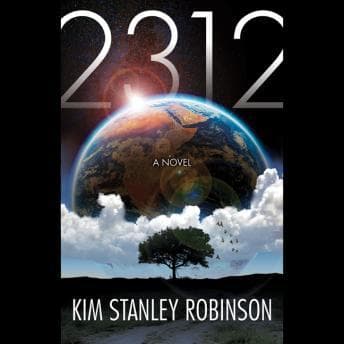

So here's the thing people don't tell you about Kim Stanley Robinson: the man writes science fiction like he's building a world for a campaign that will never end. And I mean that as the highest compliment. I started 2312 during a late-night coding session — one of those nights where my thesis code was throwing errors I couldn't even begin to parse, and I just needed something to fill the silence while I stared at stack traces. Twenty-three and a half hours later (spread across a week of procrastination, obviously), I emerged from Robinson's solar system feeling like I'd taken an actual graduate-level course in terraforming.
Mercury's Walking City Is the Dungeon Map I Never Knew I Needed
Terminator. A city on rails that literally outruns the sunrise on Mercury, perpetually rolling along tracks to stay in the habitable twilight zone. When Robinson describes how the thermal expansion of the rails themselves propels the city forward — no engine, just physics — my brain did that thing it does when a magic system clicks into place. This is Sanderson-level world-building, except there's no magic. It's all thermodynamics and orbital mechanics and the sheer audacity of imagining humans would build something like this. The closest thing I've found to this kind of rigorous, joyful scientific problem-solving in audio form is Project Hail Mary, which moves faster but scratches the exact same itch — that feeling of watching a brilliant mind work through an impossible constraint until it stops being impossible. The city feels more real than half the fantasy capitals I've read about, and Robinson spends serious time making you understand why it works, not just that it works.
And then there are the terraria — hollowed-out asteroids converted into biomes spinning through space. Some are savannas. Some are oceans. Some are ecosystems that never existed on Earth, designed by people like Swan Er Hong as living art installations. If you don't like info-dumps, this isn't for you (but you're wrong). Robinson will spend pages on the specifics of how you'd maintain atmospheric pressure inside a spinning rock, and I ate every word of it. My D&D group would love this — the terraria are basically portable demiplanes with hard science justification.
The Plot Is a Side Quest (And That's Where It Gets Complicated)
Here's where I have to be honest. The actual story — Swan's investigation into a conspiracy after the death of her grandmother Alex — is... thin. Like, surprisingly thin for a 23-hour audiobook. Robinson is way more interested in showing you what 2312 looks like than in giving you a tight thriller. Swan bounces between Mercury, Venus, Saturn's moons, and Earth, and the journey between those places is always more interesting than whatever plot point she's arriving at. There are entire sections that read like excerpts from future textbooks or lists — literally lists, sometimes of random nouns and sensory impressions — that are clearly Robinson doing something experimental with form. Some of these worked for me (the "quantum walk" passages where Swan streams consciousness across landscapes are genuinely beautiful in audio). Some of them had me checking how much time was left in the chapter.
The relationship between Swan and Wahram — she's impulsive and artistic, he's a slow-moving, toad-like diplomat from Titan — is probably the emotional core, and it's weirdly charming. But it develops at a glacial pace. Robinson is allergic to dramatic shortcuts. Everything unfolds at the speed of orbital transfer windows.
Sarah Zimmerman Does Solid Work With an Unusual Book
Zimmerman's narration is clear, steady, and professional. She handles the scientific passages without stumbling, which is no small feat given the density of Robinson's prose. But — and I say this with respect — she doesn't do what Steven Pacey would do. Steven Pacey walked so other narrators could run, and Zimmerman is walking confidently but not sprinting. Swan and Wahram don't sound dramatically different from each other; the characterization comes through pacing and tone rather than distinct vocal signatures. For a book this long and this internally varied (switching between narrative prose, fake encyclopedia entries, and stream-of-consciousness lists), a more dynamic performance might've helped bridge the experimental sections. I've heard some folks preferred Richard Ferrone's work on the Mars Trilogy, and I get that — Ferrone brings a gravitas that might suit Robinson's style better. But Zimmerman is perfectly competent. She just doesn't elevate the material the way a top-tier narrator can.
Who's Rolling a Perception Check on This One
If you want a plot-driven space opera, skip this. Seriously. You will be frustrated. But if you're the kind of person who reads RPG sourcebooks for fun — who wants to understand how a civilization actually works across multiple planets and moons, who wants to think about gender fluidity and longevity and ecological restoration as practical engineering problems rather than abstract concepts — this is 23 hours of pure world-building bliss. The progression is satisfying if you treat it less like a novel and more like an immersive tour of a future that feels earned. Robinson doesn't hand-wave anything. This is a Nebula winner for a reason, even if that reason is "the setting is so good it compensates for the plot."
I read this instead of writing my thesis. Dr. Patel, if you're reading this: I was doing research on procedural generation of habitable environments. Technically.
Campaign Notes: Worth the Long Rest
I liked this a lot. I didn't love it. The world-building is genuinely extraordinary — some of the best hard SF habitat design I've ever encountered in audio form. But the pacing demands patience, the plot meanders, and the narration is serviceable rather than transcendent. At 1.25x speed, the experimental list sections become tolerable and the descriptive passages still land. Worth your time if you know what you're getting into. Just don't expect it to move fast.