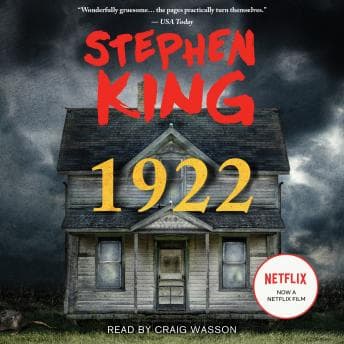

Look, I need to complain about something first: Stephen King has ruined rats for me. Forever. I was already not a fan (who is?), but after finishing 1922 on a 6AM train surrounded by commuters who probably thought I was having some kind of episode based on my facial expressions, I now have a full-blown phobia. Thanks, Steve.
Bottom Line: Worth your commute. This is basically a confession letter from a murderer, but make it Nebraska gothic and add an escalating rat nightmare that burrows into your brain.
The Slow Burn That Actually Earns It
Yeah, King's slow starts are legendary at this point. The first hour or so of 1922 is all setup—Wilfred James establishing his farm, his marriage falling apart, the land dispute with his wife Arlette. I almost switched to a podcast about database optimization (don't judge me, it was early). But here's the thing: that slow build is doing work. By the time Wilfred decides to kill his wife over a hundred acres of Nebraska dirt, you understand exactly how a man talks himself into something monstrous. The ROI on patience here is substantial.
The structure is genius for audio—it's a confession, written in first person, so Craig Wasson is basically playing a man documenting his own descent into madness. No jumping between POVs, no complicated timelines. Just one guy, one terrible decision, and the consequences that keep multiplying like... well. Like rats.
Craig Wasson Does That Thing
I wouldn't put him in the Ray Porter tier (nobody is), but Wasson absolutely nails what this story needs. His Wilfred James has this weathered, Midwestern flatness that makes the horror creep up on you. When Wilfred rationalizes murder, Wasson delivers it like a man explaining why he chose one seed corn over another. Matter-of-fact. Practical. Which makes it so much worse.
The character differentiation is subtle—he's not doing theatrical voice changes for the wife and son. Instead, it's all in the tone shifts. Arlette sounds shrill through Wilfred's biased narration, and you can hear that bias in how Wasson performs her. It's unreliable narrator stuff done through audio, and it works.
One listener review said they felt like "the narrator was the actual character, telling me what had happened," and that's exactly right. This is confession-booth energy. You're sitting there at 6:47 AM, packed between a guy eating an everything bagel and someone's enormous backpack, listening to a farmer explain how he convinced his teenage son to help murder his mother. Normal commute stuff.
The Rats, The Rats, The Rats
I can't not talk about the rats. King uses them as this escalating symbol of guilt—they start as a minor presence at the murder scene and then they just... don't leave. They show up everywhere. In walls. In dreams. In places that make no logical sense but perfect psychological sense. By the end, I was hearing phantom scratching sounds in the Caltrain's ancient HVAC system.
The audio format makes this worse (better?). You can't skim past rat descriptions like you might in print. You have to sit there and let Wasson describe them in his calm, measured voice while you grip your phone and try to look normal to your fellow passengers.
Perfect for: Commute, Gym. Skip for: Falling Asleep
At 5 hours 37 minutes, this is a tight listen. I finished it in three commutes, which is my sweet spot for novellas. The pacing after that initial slow burn is relentless—once the murder happens, it's just consequence after consequence, guilt manifestation after guilt manifestation.
Don't listen at bedtime unless you want to dream about rats. Speaking from experience here. Kevin asked why I kept checking under the bed at 2 AM and I had to explain that Stephen King had broken my brain again.
The production is clean—single narrator, no sound effects, no music. Just you and Wilfred's confession. It's the right choice for this material. Any audio embellishment would've felt cheap.
Who Gets the Most Out of This
If you like psychological horror over jump-scare horror, this is your jam. It's basically a study in how guilt destroys a person from the inside out, wrapped in early 20th century Americana. Think Poe's "Tell-Tale Heart" but with more agricultural anxiety and family murder. That same slow-burn psychological dread shows up in Nightfall, though Asimov trades guilt for existential terror.
Skip if: you need likeable protagonists, you're squeamish about rats (seriously), or you want a happy ending. This is bleak. Beautifully bleak, but bleak.
If you've seen the Netflix movie, the audiobook is worth experiencing anyway—there's something about having Wilfred's voice in your head for five hours that the visual medium can't replicate.
System Status: Fully Compromised
This is King at his most focused. No bloat, no unnecessary subplots, just a straight shot from "I convinced myself this was justified" to "everything is rats now." Craig Wasson delivers it like he's testifying at his own trial. The slow start is a feature, not a bug—it's laying groundwork for the collapse.
I finished this in 3 commutes. My brain is still processing. Could've been a blog post? Absolutely not. This needed every minute.