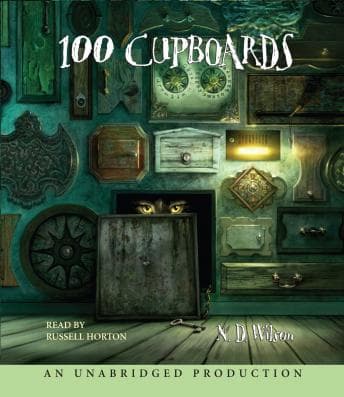

So here's the thing—everyone talks about this book like it's Narnia with a fresh coat of paint. And I get why. Kid finds portals to other worlds, there's a creaky old house, mysterious relatives, ancient evil. Surface-level, sure, it fits the mold. But after six hours with Henry York and his wall full of impossible doors, I think that comparison sells N.D. Wilson short. This understands that horror isn't about gore—it's about dread. And yes, I said horror. This is technically a middle-grade fantasy. But the best children's fantasy has always had teeth, and 100 Cupboards bites.
I was shelving returns at the library on a slow Thursday evening, earbuds in, half paying attention—until the scene where Henry starts scraping plaster off his bedroom wall and finds those doors. Different sizes, different shapes, some warm, some radiating something deeply wrong. Wilson doesn't rush this. He lets Henry sit with the wrongness of that cold cupboard, the one that breathes darkness. And suddenly I'm standing in the 398.2 section holding a copy of Goosebumps and feeling genuinely unsettled by a book aimed at twelve-year-olds. That's craft.
What's Behind Door Number Dread
Wilson does something I rarely see in portal fantasy aimed at younger audiences—he treats the unknown as actually threatening. Not "oh no, a quirky obstacle" threatening. Threatening like: you opened something you shouldn't have, and now it knows you're here. Henry isn't a chosen one. He's a kid who was raised by overprotective parents (who are currently kidnapped by foreign radicals, which is just casually dropped into the premise like it's normal), shipped off to live with his uncle and aunt in Kansas, and he's scared of basically everything. His cousin Henrietta, on the other hand, is fearless to the point of recklessness. She's the one who charges through a cupboard first, and Henry has to follow because someone has to keep her alive.
That dynamic—the cautious kid forced into bravery by someone else's boldness—is way more interesting than the standard "reluctant hero discovers inner courage" arc. Henry doesn't discover inner courage. He discovers that the alternative to being brave is letting his cousin get swallowed by whatever lives on the other side of those doors. That's not inspiration. That's survival math. I ran into similar emotional logic in Every Day—a character who doesn't choose heroism so much as run out of other options.
The worldbuilding here is suggestive rather than exhaustive. You get glimpses through cupboards—a glowing room with a pacing man, a landscape that shouldn't exist, something in the dark that presses back when you look at it. Wilson trusts the reader (or listener) to fill in the gaps, and that restraint is what makes it genuinely creepy. Shirley Jackson walked so this author could run, even if the destination is a Kansas farmhouse instead of Hill House.
Russell Horton Keeps It Grounded (And That's the Right Call)
The narrator commits. That's rare—especially in middle-grade audiobooks where the temptation is to go broad and cartoonish with every character voice. Horton doesn't do that. His pace is steady and measured, his voice clear without being sterile, and he differentiates the rapidly introduced cast well enough that you're never lost. Uncle Frank sounds different from Henry sounds different from Henrietta, and none of them sound like they're being performed by someone doing a children's theater audition.
Is it a showstopper performance? Honestly, no. Horton is workmanlike in the best sense—he serves the story, stays out of its way, and lets Wilson's prose do the atmospheric heavy lifting. For a book that relies on creeping unease more than set-piece action, that's exactly the right approach. A narrator who oversold the scary moments would've tipped this into camp. Horton plays it straight, and the tension stays intact.
The "But Is It Actually Scary" Question
If you scare easily, skip. If you don't—well, you probably still won't be terrified. But unsettled? Yeah. Wilson writes darkness the way good horror writers do: not as the absence of light but as a presence. The cupboards aren't just portals. They're wounds in the wall, and something is seeping through. For a book one in a trilogy, the restraint is impressive. We don't get answers. We get the horrible feeling that answers are coming and we won't like them.
Small caveat: there's some mild cursing. I know, I know. But a few listeners have flagged it, so if you're picking this for a kid and that matters to your household, be aware. Personally? A "damn" or two feels appropriate when you've got interdimensional evil leaking through your bedroom wall.
At six hours and change, this is a quick listen. Almost too quick—it's clearly a setup book, and it ends with more questions than answers. That's my one real gripe. The pacing in the first half is patient and atmospheric, but the back third rushes toward a cliffhanger that feels like Wilson suddenly remembered he had two more books to sell.
File This Under: Portals You Shouldn't Open
My podcast listeners are going to love this as a palate cleanser between heavier horror recs. It's not adult horror, but it's horror-literate in a way that most middle-grade fantasy refuses to be. If you grew up on The House With a Clock in Its Walls or Bellairs' gothic sensibility, this is your next listen. If you need resolution in book one, wait until you can binge the whole trilogy. And if you're a librarian who listens to children's fantasy while shelving and occasionally freaks out a patron by muttering "don't open that door" to nobody—well, that's between me and the 398.2 section.