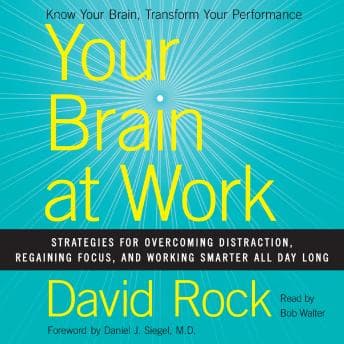

I was chopping onions for a chana masala at 10 PM on a Tuesday — the kind of elaborate solo cooking project that my therapist would probably call "productive avoidance" — when David Rock introduced me to Emily and Paul, and I immediately thought: oh, we're doing case studies. My people.
Here's the thing. I'm a psychologist who reads self-help books the way a mechanic watches car commercials — with suspicion and an involuntary twitch whenever someone oversimplifies cognition. So when I tell you that Your Brain at Work mostly held up under my scrutiny, that's not nothing.
Emily and Paul Are Basically Lab Rats With Mortgages
Rock's structural choice here is genuinely clever and, I think, undersold. Instead of a standard "here's a concept, here's how to apply it" format, he builds each chapter around fictional scenes from Emily and Paul's workday — a meeting gone sideways, an email avalanche, a difficult conversation with a colleague — then rewinds and replays those same scenes with neuroscience-informed strategies applied. It's like a psychological "choose your own adventure" where the wrong path is the one you're already living.
The protagonist(s) exhibit classic cognitive overload patterns that anyone with a job and a pulse will recognize. Emily trying to prioritize her to-do list while simultaneously processing new information? That's not just relatable, it's a perfect illustration of what Rock calls the "stage" — his metaphor for the prefrontal cortex's severely limited working capacity. He argues your conscious processing space is smaller than you think, maybe holding four items on a good day, and every decision, every email triage, every context-switch eats into that bandwidth.
Psychologically, this tracks. The research actually shows that prefrontal cortex fatigue is real and measurable, and Rock does a decent job citing work from researchers like Matthew Lieberman, Naomi Eisenberger, and others. He's not making things up. He's popularizing, sure, but he's not butchering the science — which puts him ahead of about 80% of the brain-hack genre.
Where the Wiring Gets Interesting (and Where It Shorts Out)
The sections on the "toward" and "away" response — basically approach vs. avoidance motivation — and the SCARF model (Status, Certainty, Autonomy, Relatedness, Fairness) were the meatiest parts for me. Rock's argument that social threats activate the same neural circuits as physical threats isn't new if you've read any social neuroscience, but the way he applies it to workplace dynamics — why feedback feels like an attack, why micromanagement triggers a threat response equivalent to someone lunging at you — is genuinely useful. I found myself asking: why does giving someone constructive criticism at work feel so disproportionately terrible? Rock gives a neurological answer that's satisfying without being reductive.
But. And this is a real but.
The book is from 2009. The neuroscience isn't outdated exactly, but some of the framing feels like it belongs to a slightly earlier era of pop-neuro enthusiasm where "your brain does X" explanations were treated as revelatory. If you've read anything by Daniel Kahneman, or even a solid psych blog in the last five years, some of these insights will land with a soft "yes, I know" rather than a gasp. The research foundation is solid; the novelty has a shelf life.
Also — and this is my specific gripe — the Emily and Paul scenarios occasionally feel a bit too neat. Real human decision-making is messier than "apply this one reframe and watch the scene improve." The author understands human nature, but sometimes the fictional illustrations flatten the complexity that makes psychology, well, psychology. My therapist would have thoughts about how easily these characters course-correct once given the right framework. Real people are more stubborn than that. Trust me, I study them.
Bob Walter Does the Job, Nothing More
Bob Walter's narration is competent and clear. He reads like a well-prepared business audiobook narrator — steady pacing, good enunciation, no distracting vocal tics. He doesn't do wildly different voices for Emily and Paul, which is fine because this isn't really a character-driven narrative. It's a framework book with characters as vehicles. But I will say: at nearly 10 hours, a more dynamic delivery would've helped during the denser neuroscience explanations. There were stretches during my morning jog through Cambridge where I had to actively resist the urge to zone out — which is ironic for a book about focus. I bumped the speed to 1.25x around hour five and never looked back.
Who Should Put This in Their Ears
If you're someone who's never really dug into cognitive psychology or behavioral neuroscience, this is a genuinely solid entry point. The Emily-and-Paul structure makes abstract concepts concrete, and Rock connects brain science to daily work life in ways that feel practical rather than academic. The same attempt at bridging psychology and everyday life shows up in Men Are From Mars, Women Are From Venus, though honestly, that one made my inner psychologist twitch a lot harder — the frameworks there are far less evidence-based, but it's an interesting comparison in how differently two authors can popularize behavioral science. If you're already steeped in this literature — Kahneman, Duhigg, maybe some Lieberman — you'll find the content familiar, though the workplace application angle might still offer something.
Skip it if oversimplified fictional scenarios make you twitchy. You've been warned.
The Case File, Closed
This is a fascinating case study in how to make neuroscience useful without making it stupid. Rock doesn't always succeed — the scenarios are too clean, the solutions too tidy — but the core framework is honest, evidence-based, and genuinely applicable. I finished it, went back to my chana masala (which had gone cold, naturally), and caught myself prioritizing my next-day tasks using his "stage" metaphor before I even realized I was doing it. So. That's something.