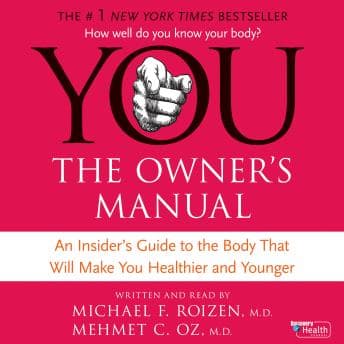

"Your body is basically the most sophisticated machine you'll ever own, and you don't even have the manual."
That line hit me somewhere around mile marker 3 on Tuesday's southbound Caltrain, sandwiched between a guy snoring into his North Face and someone's leaking AirPods playing Bad Bunny. And honestly? It's a pretty solid thesis for a book that's trying to be the README.md for human biology.
Your Body as a Distributed System (And You're a Terrible SysAdmin)
Here's the thing about YOU: The Owner's Manual - it's basically "man pages" but for your organs. Oz and Roizen walk through each major body system like they're onboarding a junior engineer: here's the heart, here's how it fails, here's the monitoring you should've set up years ago. The structure is organ-by-organ, which makes it surprisingly easy to follow in audio format. Heart. Brain. Lungs. Immune system. Bones. Sensory organs. Each gets its own chapter with a clear mental model of how things work, how they break, and what your maintenance schedule should look like.
What actually impressed me is the "RealAge" framework Roizen brings in - the idea that your biological age and chronological age diverge based on your choices. As someone who stares at monitoring dashboards for distributed systems all day, I genuinely appreciated the framing. Your body has health checks. You can observe failure modes before they cascade. Inflammation is basically your body's equivalent of a memory leak - silent, cumulative, devastating.
The section on arterial health was the one that stuck with me most. They argue that the biggest threat to your arteries isn't cholesterol per se, but inflammation and oxidation damage to arterial walls. It's a more nuanced (wait, banned word - let me say layered) argument than the typical "cholesterol bad" narrative, and they explain the mechanism clearly enough that I could follow it at 6:15 AM. That's the bar.
The 100 Q&A questions near the end are genuinely useful - things like whether memory loss is inevitable (it's not, mostly), whether exercise has diminishing returns (also not really how it works). Good myth-busting with actual citations.
Two Doctors Walk Into a Recording Booth
Oz and Roizen narrate this themselves, and - look, they're doctors, not Ray Porter. The delivery is clear, accessible, and you can tell they actually care about the material. There's a warmth to hearing authors read their own work, especially when you can hear them get excited about explaining, say, how your immune system occasionally misfires and attacks your own cells. That said, the performance is pretty flat dynamically. No real variation in energy across 6+ hours. It's like pair programming with two very enthusiastic but monotone senior engineers. You'll learn a lot, but nobody's winning an Audie for vocal range here.
(They did win the Audie for Personal Development in 2009, which - fair. The content earned it even if the delivery is workmanlike.)
The repetition issue is real. If you've listened to "You: On a Diet" or any of their other books, you'll get deja vu in multiple sections. Some concepts get restated two or three times within the same chapter, which at 1.5x was fine but at 1.0x would've driven me nuts. I bumped to 1.75x for the nutrition guidelines section because it really could've been a blog post. Or a pamphlet. A well-organized pamphlet, but still.
Honestly, that same instinct toward ruthless simplification of complex systems is what made Spark Joy click for me - Kondo treats your living space like a codebase that needs refactoring, not a museum to feel guilty about.Who Gets the Most ROI Here
Perfect for: train, gym, car. Skip for: bedtime (you'll zone out during the repetitive bits and miss the actually useful stuff).
If you're someone who has never really thought about how your body works at a systems level - this is genuinely great. It's Health 101 with good analogies and practical advice. The ROI on this audiobook is high if you're starting from zero on body literacy.
If you're already reading health/science books regularly, or if you've consumed other Oz/Roizen content, the marginal value drops fast. You'll get maybe 20% new information and 80% "yeah, I know, inflammation bad, omega-3s good, sleep matters."
Kevin actually listened to this one before me (he's on a health optimization kick after turning 30) and his review was: "Good info, annoying when they repeat themselves, would've been better as a podcast series." I mostly agree, except I think the structured organ-by-organ approach works better as a book than it would chopped into episodes.
TL;DR: Debug Your Meatsuit
TL;DR: Worth your commute if you want a solid, accessible overview of how your body actually works - think of it as the documentation you should've read before deploying to production. The authors narrating adds authenticity but not performance flair. Repetitive in spots, but the core science actually holds up and the practical advice is actionable. I finished this in 4 commutes at 1.5-1.75x, and I've already changed two things about my morning routine because of it. That's a decent return on 6 hours.