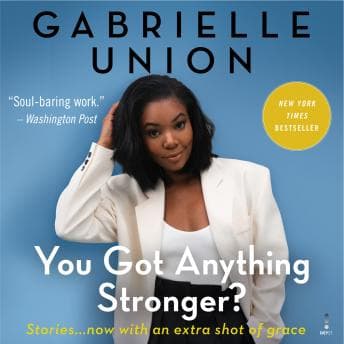

Look, I'll be honest — this isn't my usual lane. Celebrity memoir isn't business strategy. There's no framework, no 2x2 matrix, no actionable takeaways I can plug into a client deck. Jenny put this on the shared Audible account after she saw me doom-scrolling LinkedIn at midnight, and I figured I'd give it 20 minutes on the treadmill before switching back to something about OKRs.
I finished the whole thing in two sessions. We're not going to dwell on that.
The ROI on Vulnerability Is Higher Than You Think
Here's what caught me off guard: Gabrielle Union is running her life like a business, and she knows it. The surrogacy chapters — where she walks through the IVF failures, the miscarriages she can't even count, and then the decision to use a surrogate for Kaavia James — that's not celebrity oversharing. That's someone doing a brutally honest post-mortem on years of silent failure. I've sat in boardrooms where founders can't admit a product launch flopped. Union is standing in front of millions saying "my body failed me repeatedly and I grieved alone because I thought vulnerability was weakness."
My mom carried that same energy for decades. Fourteen-hour days at the dry cleaner, never once admitting she was exhausted, never once asking for help. Union puts language around that particular kind of suffering — the kind where you perform strength because you think that's all people will respect. This is what my parents did instinctively. Now it has a TED talk. Except Union does it better than most TED talks because she doesn't wrap it in a neat bow.
When the Author IS the Narrator, You Can't Hide
Union reading her own book is the whole argument for author-narrated memoirs. Her voice shifts when she's talking about the entertainment industry's racism versus when she's recounting a girls' night at Chateau Marmont — and the shift is subtle, not performative. There's this moment where she's addressing Isis from Bring It On directly, like having a conversation with a past version of herself, and her tone gets this weird mix of affection and cringe that no hired narrator could replicate. Rob Lowe's Stories I Only Tell My Friends proves the same point; his voice adds a layer of self-awareness no hired narrator could manufacture.
But — and Jenny would say I'm being harsh, Jenny is right — the pacing is uneven. Some chapters feel like she's riffing with a friend at brunch (fun, loose, a little long), and others hit with the precision of a well-structured argument. The chapter on challenging NBC and America's Got Talent over their treatment of her? Tight. Focused. Receipts included. That's the Union I wanted more of. The Chateau Marmont girls' night stuff? Charming but I was itching for the fast-forward at 2.0x.
At 8 hours and change, this is pretty lean for a memoir, which I respect. But there are probably 6 hours of essential content here. Skip to the IVF and surrogacy chapters, the industry accountability sections, and her reflections on marriage and aging. Thank me later.
What My Parents' Dry Cleaner Taught Me About This Book
The chapter that actually stopped my treadmill was Union talking about being a Black woman aging in Hollywood — an industry that treats women over 40 like depreciating assets. She frames it not as complaining but as a market analysis: here's the structural problem, here's what I'm doing about it, here's what I need from you. That's consulting language. She's diagnosing a system and proposing interventions.
My parents never had the luxury of diagnosing the system. They just survived it. Union has the platform and the language to do both, and she uses it. Not perfectly — some of her institutional critiques could've gone deeper, and there are moments where the celebrity lifestyle details create distance from the very people she's trying to connect with. But the intent is real. I've seen enough performative corporate diversity initiatives to recognize the difference between someone checking a box and someone doing the work. Union is doing the work.
Who Gets the Most From This Pour
If you're looking for a business book, this isn't it. But if you're a founder, a leader, or frankly anyone who's been performing strength while quietly falling apart — and let's be real, that's half the people I consult for — Union's framework for vulnerability-as-strength is worth the listen. The key takeaway is worth the listen. The other 7 hours? Most of them actually earn their place too, which is more than I can say for the last three business books I abandoned.
Women navigating fertility struggles, career pivots after 40, or institutional pushback will find specific, lived insight here. Guys like me who think efficiency is a personality trait might accidentally learn something about emotional intelligence. Accidentally.
Bottom line: I came in expecting celebrity fluff. I got a memoir that operates like a case study in what happens when you stop optimizing for other people's comfort and start optimizing for truth. Finally, a book that respects your time — mostly — and earns its emotional asks. Jenny's already queued up the first book. I'm pretending to resist.