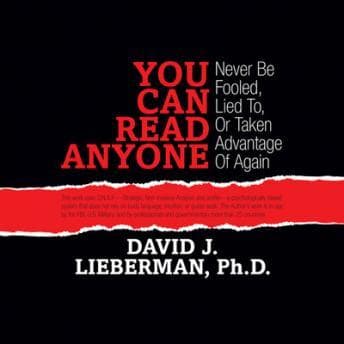

The Promise vs. The Basement Recording
Okay, so here's the thing. I wanted to love this. I really did. A psychologist who can supposedly read people better than a polygraph? Who's been on Fox News doing live demonstrations? That's basically debugging human behavior, and as someone who spends her days debugging distributed systems, I was here for it.
But then I hit play.
Look, I've listened to audiobooks recorded in what I can only assume were closets, cars, and one memorable case that sounded like a bathroom (the reverb was... distinctive). But this? This sounds like Dr. Lieberman found a reel-to-reel tape recorder in his grandmother's basement circa 1987 and thought, "Yeah, this'll do." The audio quality is genuinely rough. Like, I had to crank my volume way up on the Caltrain, which meant everyone around me could hear snippets about detecting deception. Pretty sure the guy next to me thought I was planning something.
When the Content Saves the Day (Mostly)
Here's where it gets complicated. Because underneath that questionable audio is actually some solid, practical stuff.
Dr. Lieberman isn't doing the typical body language thing where they tell you crossed arms means someone's defensive (spoiler: sometimes people are just cold). He's giving you specific frameworks for reading situations - poker tells, sales negotiations, first dates, high-stakes conversations. The techniques feel like algorithms for human behavior. Input: observe these specific cues. Process: apply this framework. Output: reasonable confidence about what's actually happening.
I finished this in about 2.5 commutes, and honestly? I caught myself using some of his techniques in a meeting the next day. We were doing a post-mortem on a production incident, and I was watching for the specific signs he describes when someone's being evasive versus genuinely uncertain. (The engineer was genuinely uncertain, for the record. Poor guy just didn't know what broke.)
The ROI on this audiobook is decent if - and this is a big if - you can get past the delivery.
The Narrator Problem (It's Him)
So Dr. Lieberman narrates his own book. I usually love author-narrated nonfiction because you get the emphasis they intended, the pauses where they want you to think. But his delivery is... fast. Like, really fast. I listen at 1.5x default, and I actually had to slow this one down to 1.25x, which never happens with self-help books. Usually I'm speeding these up because they're padded with fluff. Big Magic had that same no-nonsense density—every chapter packed with actual insights instead of motivational filler.
This isn't padded. It's dense. Which is good! But combined with his rapid-fire delivery and the basement audio quality, it becomes genuinely hard to follow during my 6AM zombie commute. I found myself rewinding sections because I'd zone out and miss a key concept. That's a problem.
He's clearly an expert. His confidence is almost overwhelming - you can tell this is a guy who's demonstrated these techniques on live TV and knows they work. But there's a difference between knowing your stuff and being able to teach it in audio format. Ray Porter he is not. (Ray, if you're reading this, please consider re-recording every self-help book ever. I will personally fund the Kickstarter.)
Who Should Listen (And Who Should Skip)
Perfect for: people who can handle rough audio and want practical psychology techniques. If you're in sales, HR, negotiations, or just perpetually confused by human behavior (hi, fellow engineers), there's value here. Skip if: you need clean production to focus, you're listening in noisy environments, or you want warm, engaging narration. This is more lecture than conversation.
Bottom Line
At 3 hours and 19 minutes, it's mercifully short. Could've been a blog post? Actually no, there's enough here to justify the length. But could've been a better recording? Absolutely yes.
The content is solid 4-star material trapped in a 2.5-star audio package. I'm splitting the difference. If you're curious, maybe grab the physical book instead - same information, no basement acoustics. But if you're stubborn like me and insist on audiobooks, slow it down to 1.25x and maybe don't attempt it at 6AM. Your brain will thank you.