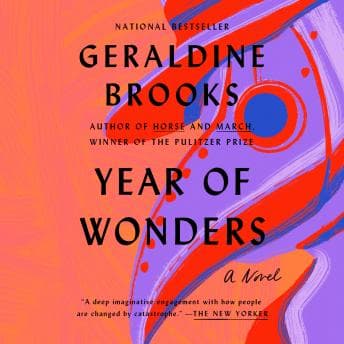

Look. I love Geraldine Brooks. I really do. The woman won a Pulitzer. She can write sentences that make you feel like you're standing in the mud of 17th century England, smelling the plague smoke. But somebody - SOMEBODY - should have gently, lovingly taken the microphone away from her and handed it to a professional narrator. I'm sorry. I had to say it.
I started this one on a Saturday morning, rare day off, Carlos had taken the kids to his mom's house, and I had the whole kitchen to myself with coffee and pan de sal. Perfect setup for a historical fiction deep-dive. And the story hooked me immediately - Anna Frith, this housemaid in the village of Eyam, watching plague roll in on a bolt of cloth from London. A village that voluntarily quarantines itself. In 1666. As someone who worked through a pandemic in a trauma center, the idea of an entire community choosing to lock itself down to protect surrounding villages? That hit different. That hit real.
The Story That Made Me Forget My Coffee Was Cold
The writing is gorgeous. Brooks builds Anna's world with this lived-in texture - the herb garden where Anna learns to make remedies, the way she describes the plague sores with clinical accuracy that honestly impressed me (as someone who's actually worked a code, I appreciate when writers do their homework on the body's uglier moments). The progression from faith to fear to full-blown witch-hunting felt sickeningly familiar. I kept thinking about Fallout, which traces a similarly ugly arc of communities turning on the people trying to protect them when fear outpaces reason. There's a scene where the villagers turn on two women, Mem and Anys Gowdie - the village healers, essentially the nurses of their time - and the mob violence is written with such restraint that it's worse than if Brooks had been graphic about it. You feel Anna's helplessness. I felt it in my chest.
And the quarantine itself. The rector, Michael Mompellion, convincing this terrified village to seal itself off. The way Brooks shows how confinement breaks some people and transforms others. Anna losing her children early on and then finding purpose in healing work - that arc is earned, not sentimental. She's not a saint. She's surviving. I know that look. I've seen it on colleagues' faces at 4 AM when we've lost someone and there are six more hours on the clock.
The ending though - I have feelings about the ending. It takes a sharp left turn into territory that felt rushed and a little soap-opera-ish compared to the careful, grounded storytelling of the first nine hours. I won't spoil it, but Carlos asked why I was yelling "WHAT?" in the kitchen and I didn't have a good answer.
Geraldine, Honey, Writing and Reading Are Different Jobs
Here's where I have to be honest, because this is an audiobook review and not a book review. Brooks narrates her own novel, and it's... a problem. Her delivery is flat. Consistently flat. The plague is ravaging households and Anna is discovering bodies, and Brooks reads it with the same energy as someone reading a grocery list. There are moments - actual throat-clearing sounds left in the recording - that pulled me right out of the story. In emotional scenes where Anna is grieving her boys, where she's watching her neighbors die, I needed the voice to carry some of that weight. It didn't.
Some people apparently love author-narrated audiobooks on principle, and I get that. There's an intimacy to hearing the writer's own voice. But intimacy requires presence, and Brooks sounds removed from her own material. I found myself wanting to bump the speed up to 1.25x just to inject some energy, and that helped a little, but it shouldn't be my job to fix the pacing.
I will say this: there's another version narrated by Stina Nielsen that apparently exists. If you can find it, that might be the move. The story deserves better audio treatment.
Who This Is For (and Who Should Just Buy the Paperback)
If you loved pandemic-era fiction before pandemics were trendy. If you're a history nerd who wants to know what plague quarantine actually looked like at the village level. If you appreciate a female protagonist who earns her strength through loss rather than having it handed to her. This story is for you.
But if flat narration drives you up the wall - and I mean truly monotone, not just "understated" - consider the print version instead. The writing is strong enough to survive a mediocre reading, but you'll be fighting the delivery the whole time. I stuck with it because the story earned my attention. Not everyone will have that patience.
My mom would love this. She'd call me afterward and say "See, that girl became a healer, she should have been a doctor too." Some things never change.
Night Shift Prescription
Read the book. Listen to it only if you can handle the narration or find the Nielsen version. The story of Eyam deserves your time - it's a pandemic narrative written before we all became exhausted by pandemic narratives, and it still feels urgent and human and true. Just maybe don't listen to it right after a brutal shift. The death count hits different when you've been counting your own.