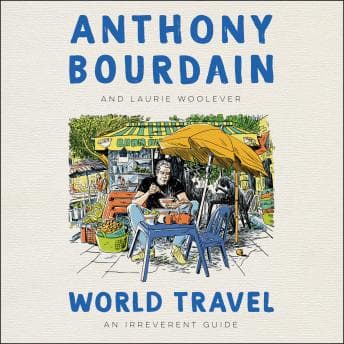

I'm going to say something that might get my English teacher card revoked: I spent twelve hours listening to a book organized alphabetically by country. Argentina before Australia before Borneo. No narrative arc. No thematic progression. Just... the alphabet. And I loved it anyway.
This is the kind of thing that would make my curriculum committee weep, but here's the truth—I graded my way through an entire stack of sophomore essays while hopping from Buenos Aires to Beirut to Bhutan. The format that should have driven me insane actually worked perfectly for 11 PM paper-grading sessions. You don't need to remember where you left off when every chapter is its own little universe.
The Ghosts at the Table
Bourdain isn't here to read his own words, and that absence sits heavy over everything. The book knows it. The narrators know it. We all know it. What we get instead is something stranger and more tender than a standard travel guide—a séance conducted by the people who actually knew him.
Shep Gordon reads with this casual, friendly warmth that occasionally catches Bourdain's rhythm. Christopher Bourdain's sardonic accounts of traveling with his brother feel like eavesdropping on family dinner conversations—the kind where someone's definitely getting roasted. Steve Albini's Chicago cheap eats guide is exactly the kind of curmudgeonly, specific, opinionated thing Bourdain would have appreciated. (My students would hate Albini's delivery. I found it refreshing.)
But here's the problem nobody wants to talk about: whoever reads the main Bourdain material—the actual travel entries—has a voice that made me wince. Multiple times. There's this quality that sounds like someone perpetually needing to clear their throat, and over twelve hours, it becomes... a lot. I found myself looking forward to the guest essays just for the vocal relief.
When Friends Try Too Hard
Some of the narrators overcompensate. They drop f-bombs with the enthusiasm of teenagers who just discovered cursing, trying to capture Bourdain's irreverence through sheer profanity volume. This reminds me of what Hemingway said about exclamation points being like laughing at your own jokes—you can't manufacture authenticity by cranking up the swear count.
The real magic happens in the quieter moments. Bill Buford on Lyon. The way certain narrators let Bourdain's observations about Oman's Empty Quarter just... breathe. The prose deserves to be savored, and the best narrators here understand that pause is punctuation.
A Travel Guide You'll Never Actually Use
Let's be honest about what this is: you're not taking this to Tanzania and consulting it for restaurant recommendations. The practical advice—where to stay, what to eat—exists, but it's wrapped in so much personality and context that it functions more as memoir than guidebook. And that's fine. That's probably better.
What Bourdain actually gave us was permission to be curious. To eat the weird thing. To talk to strangers. To recognize that travel isn't about checking boxes but about paying attention. That same philosophy of paying attention—really seeing what's in front of you—runs through Life, though Keith Richards applies it to music and chaos instead of food. The supplemental PDF that comes with the audiobook apparently has maps and addresses, but I never opened it. Worth pausing the faculty meeting for? The stories, yes. The logistics, probably not.
The Bittersweet Part Nobody Warned Me About
I wasn't prepared for how sad this would make me. Not in a manipulative way—the book doesn't lean into grief. But listening to friends and family narrate their memories of traveling with someone who's gone, hearing places described by a voice that's been silenced... it sneaks up on you.
Denise caught me getting misty-eyed during a chapter about Vietnam while we walked the lakefront. I blamed the wind. She didn't believe me.
The affection these people have for Bourdain comes through in every essay, every aside, every carefully chosen anecdote. It's a posthumous tribute that somehow avoids feeling exploitative. Woolever, his longtime assistant and co-author, clearly assembled this with care.
Who Should Pack This—And Who Should Skip It
If you want Bourdain's voice, literally—you won't get it here. If you want a coherent travel narrative—the alphabet thing will frustrate you. If you're hoping for a practical guidebook—stick with Lonely Planet.
But if you want to spend twelve hours in the company of someone who saw the world with relentless curiosity, filtered through the memories of people who loved him? If you're an armchair traveler who reads for the feeling of being somewhere else? If you, like me, appreciate when writers treat readers like adults who can handle complexity and contradiction? Then yeah. This is your kind of book.
Class Dismissed
My students would probably find it slow. They'd want more action, less observation. They're not wrong that it meanders. But that's the point. The best travel isn't efficient. Neither is this.