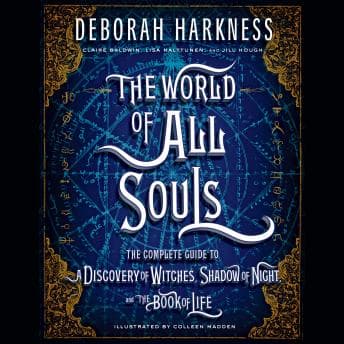

Look, I need to be upfront about something: this is basically a wiki in audiobook form. And I mean that in the best possible way.
I devoured the All Souls trilogy a few years back during a particularly brutal sprint cycle at work—the kind where you're debugging memory leaks until 11pm and need something to keep you sane on the train home. So when I saw there was a companion guide, I figured it'd be a nice nostalgia trip. What I didn't expect was to spend 15 hours essentially getting a graduate seminar on vampire genetics, alchemical history, and 16th-century Oxford architecture. As someone who spends her days thinking about distributed systems, I have a deep appreciation for well-organized reference material. This delivers.
The Database You Didn't Know You Needed
Here's the thing about companion guides in audio format—they can go very wrong, very fast. Nobody wants to listen to someone read a glossary at them for 15 hours. But Harkness structured this smart. You get synopses, sure, but also deep dives into the actual history and science she wove into the fiction. The sections on creature biology? Genuinely interesting. She approaches vampire and witch physiology with the same rigor you'd expect from a peer-reviewed paper, which—okay, that sounds dry, but it's not. It's the kind of nerdy detail work that makes you go "oh, THAT'S why that plot point worked."
The character bios are comprehensive without being tedious. If you're the type who forgets minor characters between books (guilty), this is basically a lookup table for the entire series. That same obsessive attention to character detail is what made Testaments: The Sequel to The Handmaid's Tale work so well—Atwood knows you need those connections to land. I found myself rewinding a few times just to catch details I'd missed in the original trilogy.
Four Narrators Walk Into a Recording Booth
Saskia Maarleveld handles the main narration, and she's solid—good pacing, clear delivery, doesn't get in the way of the content. But here's where it gets interesting: Deborah Harkness herself pops in, along with Steve West and Jennifer Ikeda. Having the author read certain sections adds this layer of... authenticity? Like you're getting the information straight from the source rather than through an interpreter.
The production also includes original music by Isaias Garcia, which—I'll be honest—I barely noticed on my 6AM commutes. But it's there, and it's unobtrusive, which is exactly what you want from background scoring in a reference audiobook.
One caveat: there's a bonus PDF with recipes, images, and translations. Obviously you're not getting the full visual experience in audio format. This is one of those rare cases where the audiobook is genuinely a different product than the physical book. If the artwork and maps are a big draw for you, you might want the hardcover for your shelf and the audio for your commute.
Who Gets Value Here (And Who Doesn't)
The ROI on this audiobook really depends on how deep you went into the original trilogy. If you read them casually and moved on, this might be overkill. But if you're the type who builds mental models of fictional worlds (I see you, fellow engineers), this is basically documentation for a really well-designed system.
I finished this across about five commutes, and honestly? It made me want to re-listen to the whole trilogy. Which is either a recommendation or a warning, depending on how you feel about 100+ hours of vampire-witch romance.
Skip this if you haven't read the trilogy—it'll spoil everything and make zero sense. But if you loved the books and you're the kind of person who reads wiki pages about fictional characters (again, guilty), this is basically that experience but with better production value and Harkness's actual voice guiding you through it.
The TV adaptation is pretty good too, by the way. Teresa Palmer and Matthew Goode have chemistry. But this companion guide goes way deeper than the show ever could.
System Requirements
Perfect for: long commutes, background listening while doing mindless work. Skip for: deep focus sessions—you'll want to actually pay attention to catch the good stuff.