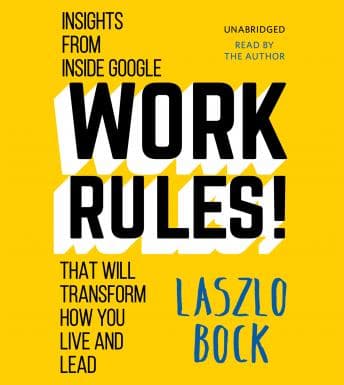

Everyone raves about Google's culture like it's some kind of Silicon Valley Hogwarts where free lunches and bean bag chairs magically produce billion-dollar products. So I went into Laszlo Bock's Work Rules! expecting 11 hours of self-congratulatory HR theater. I was wrong about maybe 60% of it. Which, for a business book written by someone who ran People Ops at the most mythologized company on earth, is actually pretty impressive.
I was up at 5 AM prepping a deck for a Series B startup that can't figure out why their best engineers keep quitting. Had Bock in my ears while making coffee, and by the time Jenny came downstairs I was scribbling notes on a napkin about structured interviewing. She asked if I was okay. Fair question.
The Stuff Your HR Department Should Actually Steal
Here's what separates this from the mountain of "culture" books collecting dust in my Audible library: Bock brings receipts. Real data. Google ran experiments on their own workforce like lab rats - thousands of them - and Bock walks you through the methodology. The section on hiring is genuinely excellent. His argument that most interviews are worthless (he cites research showing unstructured interviews predict job performance about as well as a coin flip) isn't new, but the specifics of how Google rebuilt their process from scratch are. Four interviews max. Structured behavioral questions. Hiring committees instead of individual managers making calls. I've seen this fail at three different companies that tried to copy Google without understanding the underlying logic. Bock actually explains the logic.
The "pay unfairly" chapter is the one I keep coming back to. His argument: in most organizations, the best performer produces 2-10x more output than the average one, but gets maybe 20% more pay. So you're essentially subsidizing mediocrity. He's right. My parents ran a dry cleaning business where they were both the top performers AND the management, so the pay equity question never came up - but I've watched startups lose their best people over $15K salary disputes while happily burning $200K on underperformers. Bock puts numbers and frameworks around something good operators already feel in their gut. The same move — taking intuitive financial logic and wrapping it in hard data — is what makes Get Good with Money stick with people who already know the basics but need the framework to act on them.
Where the Google Goggles Get a Little Thick
Let's be honest about the elephant in the server room. A lot of these ideas work at Google because Google is Google. Unlimited resources. A talent magnet that attracts the top 0.1%. A business model that printed money for two decades. When Bock talks about giving employees 20% time for passion projects or removing managers' authority over pay and promotions, he's describing a system built on a foundation most companies will never have. He acknowledges this to his credit - there are sections where he talks about applying these principles at smaller scales - but the gap between "Google did this" and "your 40-person logistics company can do this" is wider than he sometimes lets on.
At 11 and a half hours, this book is also about 3 hours too long. The middle section drags through repetitive case studies that all arrive at the same destination: trust your people, use data, default to transparency. My 2.0x speed couldn't save some of those stretches. Skip to chapter 5 if you already know that traditional performance reviews are broken. Thank me later.
Bock Behind the Mic
Bock narrates his own book, which is a gamble that pays off here more than usual. He's not a voice actor - you can tell. But there's an earnestness that comes through when he's talking about experiments that failed or admitting that Google got things wrong. When he describes the early days of Project Oxygen (their research into what makes a good manager), you can hear genuine excitement. It's the sound of someone who actually cared about this work, not someone reading a manuscript for a paycheck. That said, he's got a steady, even cadence that doesn't vary much, so if you're listening during a late-night drive, maybe bump the speed up or risk drifting.
Who Gets ROI From This
If you manage people - even a small team - there's real, actionable material here. The hiring framework alone is worth the credit. If you're a founder building your first HR processes, this is one of the better starting points I've found, with the caveat that you'll need to ruthlessly adapt everything for your actual resources. If you're an individual contributor hoping for inspiration to change your own company's culture from the bottom up? Temper your expectations. Most of this requires organizational buy-in from the top.
If you're looking for a quick business book hit, this isn't it. It's dense, it's long, and it occasionally disappears into HR minutiae that only a People Ops nerd could love. But the core ideas - hire slowly, pay your best people disproportionately, use data instead of gut feelings, give people more freedom than you're comfortable with - these aren't just Google tricks. This is what my parents did instinctively with their best employees. Now it has a TED talk. And 400 pages of supporting research.
The Bottom Line on Your Next Credit
Bottom line: there's a genuinely useful 6-hour book buried inside this 11.5-hour one. The best sections on hiring, compensation, and data-driven management are as practical as anything I've recommended to clients. The padding and Google exceptionalism knock it down. Worth a credit if you manage people. Worth a library borrow if you're just curious about how the sausage gets made in Mountain View.







![Steve Jobs [unabridged audiobook] audiobook cover](/_next/image?url=https%3A%2F%2Fcovers.audiobooks.com%2Fimages%2Fcovers%2Ffull%2F9788499923406.jpg&w=1920&q=75)