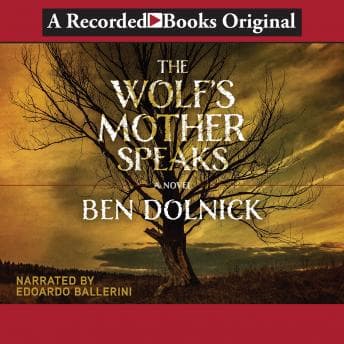

A werewolf story told from the mother's perspective. That's it. That's the pitch that made me abandon my thesis notes at 11 PM on a Tuesday.
Look, I've consumed approximately one billion fantasy novels where the cursed protagonist broods about their dark nature while the narrative camera stays locked on their tortured soul. You know what we never get? The mom. The woman who raised this kid, watched him grow up "serious" (Joyce's word, and it hits different when you realize what she's actually describing), and now has to process that her baby boy has a... substantial body count.
Ben Dolnick understood the assignment in a way that genuinely surprised me.
When Your Kid's "Phase" Involves Full Moons
Joyce is one of the most fully realized parent characters I've encountered in supernatural fiction. And I say this as someone who has sat through countless fantasy audiobooks where parents exist purely as tragic backstory fuel or obstacles to the hero's journey. Joyce is neither. She's the protagonist, and the horror of this story isn't the werewolf stuff—it's watching a mother's love contort itself into increasingly desperate shapes.
The drive upstate to find Michael after he misses his birthday? That's peak mom energy. The fact that what she discovers "strains her sanity"? Also peak mom energy, honestly. (My own mother would probably attempt to find a cure, file the appropriate insurance paperwork, and still ask when I'm graduating. Georgia moms are built different.)
What Dolnick does brilliantly is keep the supernatural elements almost secondary to the family drama. This isn't Jeff VanderMeer-style cosmic weird where you're drowning in fungal imagery—it's more intimate than that. More uncomfortable. The comparisons to VanderMeer and Victor LaValle in the description are apt for tone, but this is its own creature.
Ballerini Carries the Weight
Edoardo Ballerini. This guy. I've heard him narrate before, and he's consistently excellent, but his Joyce voice here? His work in Fourth Monkey already had me convinced he could carry dark, morally uncomfortable material, but this is a different gear entirely. The way he handles her "earthly funny lines"—and yes, they made me actually laugh out loud during what is objectively a gory, terrifying story—that's a tightrope walk most narrators would faceplant.
The humor isn't comic relief. It's the way real people cope with impossible situations. Joyce makes observations that are simultaneously hilarious and devastating, and Ballerini's delivery threads that needle perfectly. He earns genuine sympathy without ever making Joyce pathetic. She's just a mom. A mom dealing with something no parenting book covers.
At under five hours, this is basically a single-session listen. I knocked it out during a late-night coding session when I was supposed to be debugging my procedural generation algorithms. (Dr. Patel, if you're reading this—I wasn't. I was working very hard on academic things. The werewolf audiobook was research. Somehow.)
The Magic System Is... Motherhood?
Okay, hear me out. Sanderson's First Law says magic needs rules to be satisfying. The "magic" in this story—Joyce's maternal love and the lengths it drives her to—follows its own brutal internal logic. Every escalation makes sense within the framework Dolnick establishes. You understand why she does what she does, even when "what she does" involves that aforementioned substantial body count. Shift pulled a similar move on me—the supernatural mechanics kept receding into the background the longer the character logic took over, which is either a flaw or a feature depending on your patience for feelings over fireworks.
This is character-driven horror in the truest sense. The wolf stuff is almost incidental to the real monster: a mother's love that refuses to accept limits. My D&D group would have a field day with Joyce as an NPC—she'd be the quest-giver who seems helpful until you realize her definition of "helping my son" has some... flexible moral boundaries.
Who Should Take This Drive Upstate (And Who Should Stay Home)
If you want traditional werewolf action—transformation scenes, pack dynamics, silver bullet solutions—skip this one. This is literary horror wearing supernatural clothes, closer to We Need to Talk About Kevin than The Howling.
But if you're tired of fantasy that treats parents as narrative afterthoughts? If you want something genuinely unsettling that earns its darkness through character work rather than gore (though there IS gore)? If you appreciate dark humor that makes you laugh and then immediately feel weird about laughing? This one's worth your time.
The content warnings are real—violence, gore, supernatural elements, mental illness themes—but they serve the story rather than existing for shock value. Dolnick isn't trying to gross you out. He's trying to make you understand Joyce. And that's somehow worse.
Spend Your Credit, Save Your Thesis for Later
Four hours and forty-two minutes. That's nothing. That's one extended thesis-avoidance session. That's a round-trip drive to Atlanta.
The narration is excellent, the concept is fresh, and the execution lands. It's not going to change your life, but it might change how you think about werewolf stories. After the five hundredth brooding alpha protagonist, that's worth something.
Joyce would want you to listen. And you don't want to disappoint Joyce.