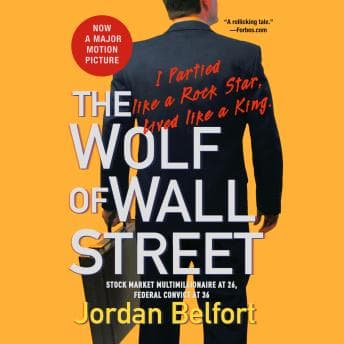

Twenty hours. That's how long Jordan Belfort takes to tell you how he made hundreds of millions defrauding investors and snorted enough cocaine to kill a small elephant. And honestly? I listened to every minute at 2.0x speed, which means I still gave this man ten hours of my life. Time I could've spent on actual business strategy. But here's the thing - I don't regret it.
Let me be upfront about what this book is and isn't. This is not a business book. I don't care that it's shelved in Business & Economics. My parents worked 14-hour days running a dry cleaning business in Koreatown. They built something real. Belfort built a criminal enterprise dressed up in Armani suits. The difference matters.
But as a case study in what happens when charisma meets zero ethics meets a regulatory environment that wasn't paying attention? It's genuinely valuable. I've consulted for startups where founders had that same Belfort energy - the "move fast and break things" mentality that sounds great in a pitch deck but lands you in federal court.
What Stratton Oakmont Actually Got Right
Here's what business schools won't teach you: Belfort was actually brilliant at certain things. His sales training methodology, stripped of the fraud, contains real insights about human psychology and motivation. The way he built culture (toxic as it was), the way he scaled operations, the systems he put in place - there's a reason Stratton Oakmont moved so much money so fast.
The book doesn't shy away from the mechanics. You get the boiler room scripts, the psychological manipulation tactics, the organizational structure. I found myself taking mental notes - not to replicate, obviously, but to recognize. I've seen echoes of these techniques in legitimate sales organizations. The line between "aggressive sales culture" and "we're probably breaking laws" is thinner than most CEOs want to admit.
Belfort's writing is surprisingly self-aware in places. He knows he was the villain. He tells you he was the villain. And then he spends three chapters describing his yacht in loving detail anyway. It's a fascinating psychological document.
Eric Meyers Commits to the Chaos
The narration. Eric Meyers absolutely crushes the Jordan Belfort voice. The arrogance, the manic energy, the salesman cadence - it's spot on. When Belfort goes on his Quaalude-fueled rants, Meyers commits fully. You believe this guy could sell ice to Eskimos and then convince them to invest their life savings in a fake company.
But - and this is a significant but - his female character voices are rough. Like, genuinely difficult to listen to for extended periods. Belfort's wife Nadine appears constantly, and every time she speaks, Meyers goes for this high-pitched, shrill register that pulled me right out of the story. I actually started speeding up those sections even more. At 2.5x, the shrillness becomes almost tolerable. Almost.
It's frustrating because the production is otherwise clean, and Meyers clearly put work into this performance. The male characters are distinct and well-drawn. But in a 20-hour audiobook, those female voice moments add up. Consider yourself warned.
The ROI Calculation
Bottom line: This book is worth your time if you approach it correctly. Don't listen to learn how to succeed in business. Listen to learn how fraud actually works at scale, how regulatory capture happens, and what unchecked greed looks like from the inside.
For my consulting work, it's been surprisingly useful. When I'm evaluating a company's culture and something feels off - that "too good to be true" energy - I think about Stratton Oakmont. Belfort describes exactly how he created an environment where smart people convinced themselves that obvious crimes were just "aggressive business practices." That pattern recognition is valuable.
The movie's great, but it's a highlight reel. The book is the full financial statement, including the footnotes nobody reads. You get the context, the buildup, the slow corruption of everyone around Belfort. It's darker and more instructive.
Jenny listened to parts of this with me on a road trip. She said, "This man is exhausting." She's right. But exhausting people often make the most instructive case studies. Skip to the Stratton Oakmont chapters if you're pressed for time - that's where the real organizational insights live. The yacht stuff and drug binges are entertaining but ultimately just rich-guy chaos.
Who should listen: Consultants, compliance officers, anyone who needs to recognize fraud patterns before they metastasize. Who should skip: Anyone looking for actual financial education or founders already showing Belfort tendencies - you need a different book. And a lawyer.
Would I recommend it to a startup founder? Depends on the founder. If they need actual financial literacy instead of cautionary tales, I'd point them to Rich Dad's Cashflow Quadrant - though that book has its own issues I've written about. If they already have ethical guardrails, sure - it's useful to see what the dark side looks like.