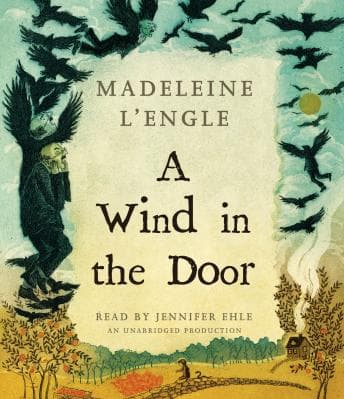

"There are dragons in the twins' vegetable garden."
That's how this book opens - a six-year-old saying something completely bonkers with total sincerity - and honestly? I related. My five-year-old told me last week there was a whale in our bathtub. At some point you just go check. Kipling understood that instinct completely - his Complete Just So Stories runs entirely on that same parental willingness to follow a child's strange logic all the way down the rabbit hole, and my kids have worn out two copies.
I picked up A Wind in the Door because Emma is reading A Wrinkle in Time for school and I wanted to stay a step ahead (parenting hack: always know what's coming so you can prep for the weird questions at bedtime). This is Book 2 in L'Engle's Time Quintet, and at 5 hours 28 minutes, it fit perfectly into my week. I started it Monday during drop-off, caught chunks during Sophie's naps, and finished it Thursday night in the car. In the garage. With a lukewarm coffee. My happy place.
Mitochondria Have Never Made Me This Emotional
Okay so here's the thing about this book that caught me completely off guard: Madeleine L'Engle takes you inside a mitochondrion. Like, literally inside Charles Wallace's cells. The whole second half of the story shrinks down to a cellular level where Meg has to fight to save her brother's life from within his own body. It sounds like a Magic School Bus episode, but L'Engle makes it genuinely terrifying and beautiful. There's this concept she introduces - "farandolae" - tiny creatures living inside mitochondria that have to choose to either root and mature or be seduced into a kind of nihilistic rebellion. And the metaphor hit me harder than I expected. Because what parent hasn't watched their kid struggle with exactly that tension? Growing up vs. giving in?
Charles Wallace is getting beaten up at school for being different. He's brilliant and strange and the world doesn't know what to do with him. I was listening to this part while parked outside Emma's school and I just... sat there for a minute after it ended. Because kids are mean, and the fear that your child is too much or not enough for the world they're in - L'Engle nails that ache in about three sentences.
The cosmic stuff is wild. There's a cherubim named Proginoskes who is basically a giant wing-covered entity full of eyes, and there's a "Teacher" named Blajeny who shows up to guide Meg through three trials. If you remember how Wrinkle had that combo of hard science and spiritual weirdness, this doubles down on it. The naming concept - where Meg has to truly Name someone to save them, meaning she has to love them fully and specifically - that's the emotional core. And it works. Even at 1.25x speed with a toddler monitor crackling in the background.
Jennifer Ehle: Warm Enough, But Not Electric
Jennifer Ehle's narration is... fine. And I mean that in the "this is perfectly adequate" way, not the passive-aggressive mom way. Her voice is genuinely warm and soothing - great for the quieter, emotional scenes between Meg and her father, and she handles L'Engle's science-meets-spirit language with real clarity. When she reads the passages about Proginoskes explaining the nature of the universe, it doesn't sound like someone reading a textbook. It sounds like someone who actually understands what they're saying.
But here's my issue: the more fantastical characters - the Echthroi (the villains, essentially forces of nothingness), Proginoskes himself - they could use more vocal distinction. Ehle keeps things in a pretty narrow register, so during the trial scenes when multiple beings are speaking, I occasionally had to rewind to figure out who was talking. Not a dealbreaker, but if you're comparing to, say, a full-cast production, this is definitely a one-woman show with limited costume changes.
She's better than L'Engle's own narration (which exists and which I sampled - love the author, but Ehle is the easier listen). So there's that.
Who's This Actually For?
If you're a parent reading ahead of your kids, this is perfect. It's short enough to knock out in a week of fragmented listening, and it'll give you real things to talk about with your 7-10 year olds. The themes of bullying, illness, and choosing love over apathy? Incredibly relevant.
If you never read L'Engle as a kid and want to start somewhere, begin with A Wrinkle in Time. This sequel assumes you know Meg, Charles Wallace, and Calvin. Jumping in here would be confusing.
If you need high-energy narration with distinct character voices and dramatic pacing - this isn't it. Ehle is steady and clear, not theatrical.
The Garage Verdict
Survived 47 pauses and still made sense - and for a book about farandolae inside mitochondria, that's saying something. Made me cry at school pickup. Worth it though. Not because the ending is sad (it's not - satisfying ending, exactly what I needed), but because L'Engle writes about loving difficult children with such specificity that it bypasses your brain and goes straight to your chest.
I'm going to read this one to Emma next month. After she finishes Wrinkle. After I figure out how to explain what a cherubim is without starting a theological debate at bedtime.