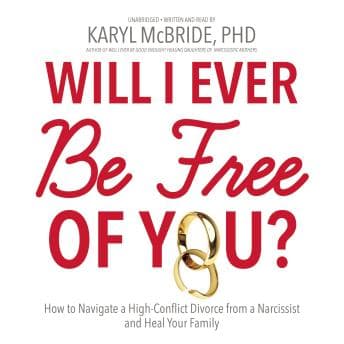

"The court system assumes that both parties in a high-conflict divorce are at fault."
I was making chai at 6 AM when Dr. McBride dropped that line, and I nearly burned my hand on the pot. Because here's the thing—this is exactly the kind of systemic blind spot I study in my research on institutional gaslighting. The research actually shows that when one party in a conflict exhibits narcissistic personality patterns, the assumption of mutual fault becomes a weapon. McBride gets this. Deeply.
When the Therapist Becomes the Narrator
There's something almost uncomfortably intimate about hearing an author read their own trauma-informed work. McBride's voice carries thirty years of sitting across from shattered people in therapy rooms, and you can hear it—the careful pacing when she describes love-bombing cycles, the slight edge when she explains how narcissists weaponize children. This isn't a narrator performing expertise. This is expertise speaking directly to you.
The three-part structure (Recognizing the Problem, Breaking Free, Healing) sounds clinical on paper, but in practice it mirrors the actual psychological journey of leaving an abusive relationship. Why does recovery literature so often fail survivors? Usually because it treats healing as linear. McBride doesn't make that mistake. She circles back, acknowledges setbacks, prepares you for the moment your ex-spouse's attorney makes you feel crazy again. Driven to Distraction grapples with a similar problem in ADHD literature—the gap between clinical understanding and lived experience.
Pattern Recognition, Not Armchair Diagnosis
What makes this book compelling is its refusal to stay purely therapeutic. McBride pivots between emotional validation and genuinely useful legal strategy. She explains how narcissists manipulate custody evaluators. How they use financial abuse as post-divorce control. How the very traits that make them charming in courtrooms make them devastating to live with.
Psychologically, this tracks. Narcissistic personality disorder exists on a spectrum, and McBride is careful to distinguish between someone who's merely selfish and someone who exhibits the full clinical pattern—grandiosity, lack of empathy, exploitation of others. She's not encouraging listeners to diagnose their exes (my therapist would have thoughts about that approach). She's teaching pattern recognition.
The section on how narcissistic parents damage children hit me particularly hard. As someone who studies how stories shape identity, I know that children internalize the narratives they're given about themselves. A narcissistic parent creates a story where the child exists only to serve the parent's ego. McBride's recovery framework for kids—helping them build their own narrative, their own sense of self—is grounded in solid developmental psychology. This connects to broader questions about how we construct identity under pressure, something I've been thinking about since reading Networking for People, which explores how we perform versions of ourselves in contexts that demand conformity.
Where It Gets Complicated
I'll be honest: this book requires focus. I tried listening during my morning jog through Cambridge and found myself rewinding constantly. The material is dense, emotionally heavy, and McBride doesn't rush. At just under seven hours, it's a reasonable commitment, but not one you can half-attend to.
The author-narrated format works for credibility but occasionally works against pacing. McBride reads like a therapist—measured, careful, deliberate. If you're someone who speeds through audiobooks at 1.5x, you might find yourself adjusting expectations. This isn't a flaw, exactly. It's a feature for the intended audience: people in crisis who need someone to slow down and actually explain things.
I also noticed the book leans heavily toward heterosexual divorce dynamics with narcissistic husbands. McBride acknowledges that women can be narcissists too, but the examples skew in one direction. Given her previous work on narcissistic mothers, this feels like a deliberate scope choice rather than oversight—but worth noting if your situation differs.
Who Needs This in Their Ears (And Who Doesn't)
This is for anyone currently trapped in the fog of a high-conflict divorce, wondering if they're the crazy one. It's for the friend who keeps going back because "he's not always like that." It's for family law professionals who want to understand why their client can't just "move on."
Skip it if you're looking for general relationship advice or a quick self-help fix. This is specialized, targeted, and assumes you're already in the thick of something terrible.
A Flashlight in a Very Dark Room
The protagonist exhibits classic trauma bonding patterns—except the protagonist is you, the listener, and McBride knows it. She's written a book that functions simultaneously as validation, education, and roadmap. The audio format works because her voice carries genuine authority without condescension.
Is it a perfect audiobook experience? No. The pacing is slow, the content is heavy, and you'll need to pause and process. But that's the point. This isn't entertainment. This is someone handing you a flashlight in a very dark room and saying, "Here. Let me show you the way out."
I finished it while cooking dinner alone (don't feel sorry for me, I prefer it), and I immediately texted the link to three people. That's the highest compliment I can give.