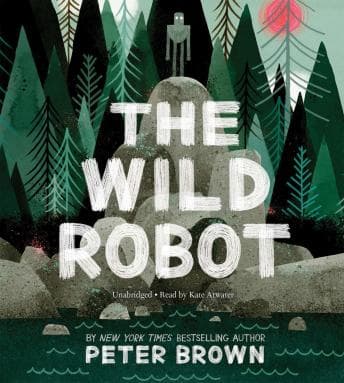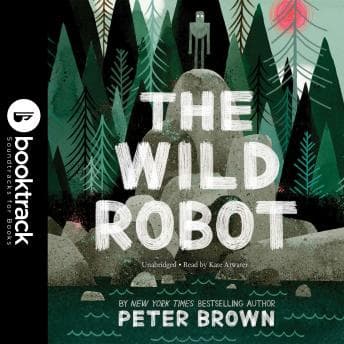

Look, I need to lodge a formal complaint. I'm a grown man with a half-finished thesis on procedural generation, and this book about a robot raising a baby goose on a wilderness island made me feel things. At 2 AM. While eating cold pizza over my keyboard. This was supposed to be a palette cleanser between Stormlight Archive re-listens, not something that would have me staring at the ceiling thinking about what it means to belong.
I blame my D&D group, honestly. One of them has kids and keeps recommending "family" books, and I keep listening because I have zero impulse control and a thesis I'm actively avoiding.
A Robot With Better Social Skills Than Me
Here's the setup: Roz is a robot who wakes up on a wild island with no memory of how she got there. Classic amnesia opening - very video game, very "you wake up in a dungeon." But instead of a dungeon crawl, she has to figure out how to survive among animals who are terrified of her. And the way Peter Brown writes her learning process? It's basically a progression fantasy for kids. Roz levels up her survival skills, her social skills, her understanding of the natural world. The progression is satisfying in that same way watching your RPG character gain abilities is satisfying.
What got me was how Kate Atwater handles Roz's voice. Early on, she's stiff, clipped, purely mechanical - think early-model NPC dialogue. But as Roz starts integrating with the island community, Atwater's delivery loosens up. The cadence softens. There's warmth creeping into the vowels. By the time Roz is mothering Brightbill the gosling, her voice has this gentle, reassuring quality that's completely earned because you heard every incremental step of the transformation. It's not a switch flip. It's a gradient. And at 4 hours 15 minutes, that's impressive economy.
Her animal voices are fun too - ChitChat the squirrel is exactly the kind of manic, motormouth energy you'd expect (basically every chaotic neutral rogue I've ever played with), and Rockmouth the fish has this gravelly grumpiness that made me snort-laugh at least twice. Each animal sounds like what it is. Simple concept, hard execution.
The Booktrack Thing - Let's Talk About It
Okay so this is the Booktrack Edition, which means there's a musical score running underneath the narration the entire time. I was skeptical. Like, deeply skeptical. I've heard audiobook "enhancements" that sound like someone left a Spotify playlist running in another tab. But this one? The music is actually calibrated to the scenes. Waves and subtle ambient sounds during the coastal moments. The score swells gently during emotional beats without drowning out Atwater's performance. It's background-level, not foreground-level.
Will it annoy purists? Probably. If you're the type who wants pure narration and nothing else, grab the standard edition. But for a kids' book - especially one you might be listening to with actual children in the car - the Booktrack layer adds atmosphere without being obnoxious. Think of it like a film score for your ears. My only wish is that I could toggle it on and off, but that's an Audible problem, not a book problem. Honestly, the last time I felt this much care put into an audio presentation was with Affair: A Jack Reacher Novel, which nails a completely different kind of atmosphere but similarly makes you feel like the production team actually gave a damn.
Who's This Actually For (Besides Thesis-Procrastinating 26-Year-Olds)
This is a family listen, full stop. It's short enough that kids won't lose the thread, the chapters are bite-sized, and the themes - adaptation, community, identity, what makes someone "alive" - are the kind of stuff that hits different depending on your age. Kids will love the animal characters and the adventure. Adults will get punched in the feelings by the questions about belonging and purpose.
If you need complex magic systems and 40-hour epics, this isn't that. (Go listen to Rhythm of War. Yes, it's 40 hours. Yes, it's worth it.) But if you want something that does a LOT with a little runtime, something with genuine heart that doesn't talk down to its audience, Roz's story delivers.
My D&D group would love this - specifically because Roz is basically a warforged druid, and I will die on that hill.
Roll for Emotional Damage
I read this instead of writing my thesis, and I regret nothing. It's a short listen, it's sweet without being saccharine, and Atwater's performance carries it with exactly the right blend of mechanical precision and growing warmth. The Booktrack edition is a nice bonus if you're into atmospheric listening. Not essential, but well done.
Now if you'll excuse me, Dr. Patel emailed me again and I need to go pretend I made progress this week.