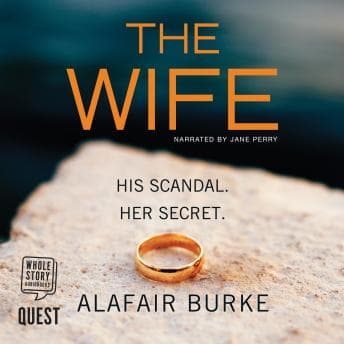

"Will Angela stand by his side?"
That's the question on the back cover, and about three hours in, sitting in my car in the hospital parking lot at 7:15 AM with the engine still running, I realized that's not actually the question at all. The real question Alafair Burke is asking is uglier, more complicated, and way more honest: What happens when the person you built your second chance around might be exactly what everyone says he is? And what if you already knew?
I should've gone inside. My shift started in ten minutes. But Burke had just dropped a detail about Angela's past - the thing she's been running from, the reason she reinvented herself - and I physically could not turn off the car.
The Part Where a Former Prosecutor Writes Like a Former Prosecutor
Alafair Burke used to put people away for a living, and it shows. The way she structures the allegations against Jason Powell - first the intern, then the second woman, then the slow drip of corroborating details - feels less like a thriller plot and more like watching an actual case file build. As someone who's sat in on depositions and dealt with hospital legal teams more times than I'd like, the procedural rhythm felt right. The way institutions close ranks. The way people's memories conveniently shift. The way a woman reporting assault gets her entire life history weaponized against her.
Burke doesn't make it easy. She doesn't hand you a villain. Jason is charming, smart, progressive - the kind of man who writes op-eds about women's empowerment. And Angela isn't just a wife standing by her man. She's a woman with secrets of her own, and those secrets are the actual engine of this book. The "#MeToo thriller" label sells it short. This is really about the stories women tell themselves to survive, and the ones they tell everyone else to keep surviving.
What I didn't expect was how much time Burke spends inside Angela's calculations. Not emotions - calculations. Every interaction Angela has after the allegations drop, she's running numbers in her head. What does she lose if she stays? What does she lose if she goes? What about Spencer, her son? What about the life she built from nothing? It's cold and practical and honestly? It's the most realistic depiction of how someone in that situation actually thinks. You don't just feel your way through a crisis. You do math.
Jane Perry Does the Quiet Work
I don't have a ton of specifics on Perry's performance from what I could find, and I'll be honest about that. But here's what I noticed: she doesn't oversell Angela. In a lesser narration, Angela would sound tortured, breathless, victimized. Perry keeps her measured. Almost clinical. Which is perfect, because Angela IS measured. She's a woman who has survived something terrible before and learned that emotion is a luxury. Perry's Angela sounds like she's always one step ahead of the conversation she's having, always editing, always choosing her words. It works.
The male characters blur a bit - Jason and his lawyer friend and the media people don't always feel distinct enough vocally. But this is Angela's story, and Perry keeps her locked in. At 9 hours, the pacing never dragged for me, though I could see someone wanting to speed up the middle section where the legal back-and-forth dominates.
What I Yelled at My Dashboard (And What Made Me Quiet)
No major medical scenes to scream about - this isn't that kind of thriller. But there's a moment where Angela describes her relationship to fear, how she's learned to metabolize it, turn it into something useful, and I had to pull over. Not because it was melodramatic. Because it was precise. Burke writes trauma like someone who's watched real people carry it - not as a personality trait or a plot device, but as a second operating system running underneath everything.
I did yell once. There's a scene involving a "toxicology panel" that's basically just a plot convenience and not how any of that actually works timeline-wise. Minor. But my car heard about it.
The ending is going to split people. It split me. Part of me wanted something cleaner. Part of me respected the hell out of Burke for refusing to give me that. She doesn't resolve the moral question. She just shows you the cost of every possible answer. I ran into something similar with Four Blind Mice — that same refusal to wrap things up cleanly, where the discomfort is kind of the whole point.
Carlos asked why I was sitting in the driveway for twenty minutes after I got home. I said I was checking email. I was actually just sitting with the last chapter.
Night Shift Prescription
This is for you if: you want a thriller that treats you like an adult. If you're tired of books where the wife is either a saint or a psychopath and nothing in between. If you've ever watched someone you loved do something questionable and had to decide in real time how much you were willing to not know. If you liked Big Little Lies but wanted it meaner and less glossy.
Skip it if: you need clear heroes and villains. If ambiguity in endings frustrates you more than it haunts you. If you want action-driven suspense - this is a slow burn that pays off in dread, not detonation.
Perfect for that post-shift decompression. Nine hours of someone else's catastrophe that makes your twelve-hour shift feel manageable by comparison. My mom would love this. (She still thinks I should've been a doctor, but she'd definitely call me to discuss the ending for forty-five minutes.)