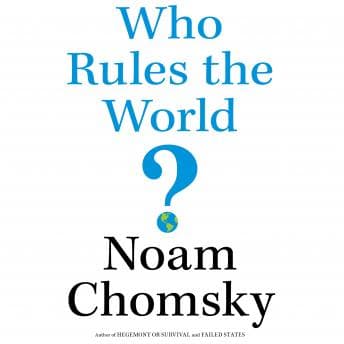

Most people either worship Chomsky or dismiss him outright. I've done neither for about twenty years now. I started reading his stuff during my second deployment - someone left a dog-eared copy of Hegemony or Survival in the TOC, and let me tell you, reading a guy systematically dismantle U.S. foreign policy while you're literally executing U.S. foreign policy is a special kind of cognitive dissonance. So when I queued up Who Rules the World? during a late-night drive back from a client site in Houston, I knew what I was getting into. Chomsky and I disagree on plenty. But the man does his homework, and after 25 years wearing the uniform, I've earned the right to hear the counterargument.
The Prosecution Rests (And Rests, And Rests)
Let me cut to the chase - this is Chomsky doing what Chomsky does. If you've read Failed States or Manufacturing Consent, you know the rhythm: meticulous sourcing, devastating examples, and a prosecutorial tone that never lets up for ten straight hours. He walks through the drone assassination program, the chaos we left in Iraq and Afghanistan, nuclear brinksmanship, and Israel/Palestine with the kind of footnote density that would make an intelligence analyst jealous. The man cites declassified documents the way most authors cite Wikipedia.
Here's where it gets uncomfortable for someone like me. His chapter-by-chapter breakdown of how U.S. policy decisions played out on the ground - I've seen some of those outcomes firsthand. Not all of his conclusions land (his framing of military decision-making can be reductive, treating complex operational realities like they're simple chess moves by elites), but enough of his evidence checks out that you can't just wave it away. I've sat in briefing rooms where the gap between stated objectives and actual outcomes was exactly as wide as Chomsky describes.
But here's the thing - and this is where it lost me in stretches - the book reads like a collection of essays more than a cohesive argument. You'll get a devastating section on drone policy, then pivot to Cold War history, then jump to climate, and the connective tissue is sometimes just... Chomsky's general thesis that American empire is bad. By hour six, you're getting diminishing returns. Same evidence pattern, same rhetorical structure, different topic. It's like sitting through a briefing where the colonel keeps making the same point with new slides.
Brian Jones Carries the Load
Now, Brian Jones narrating Chomsky is an interesting pairing. Chomsky's own speaking voice is - let's be diplomatic - not built for audiobook consumption. Flat, nasal, professorial. Jones brings a steadiness and clarity that makes the dense material actually listenable during a long drive. His pacing matches the weight of the content; he doesn't rush through the policy analysis or try to inject drama where Chomsky clearly didn't intend any. The modulation is controlled and professional - when Chomsky's prose shifts from dry documentation to genuine moral outrage (his passages on Palestinian suffering hit hard), Jones adjusts without overplaying it. The Israel/Palestine material in particular carries a weight I've only encountered matched in fiction — Leon Uris's Exodus: A Novel of Israel puts human faces on that same conflict from a completely different angle, and I'd argue reading both back to back is one of the better ways to understand why that ground never stops burning.
No complaints on audio quality. Clean production, no weird artifacts or volume inconsistencies. For a ten-hour political treatise, that matters more than people realize. Nothing kills dense nonfiction faster than having to rewind because the narrator swallowed a sentence.
Where Chomsky and I Part Ways (And Where We Don't)
I'll be straight with you - if you're active duty or recently separated, parts of this book will piss you off. Chomsky's framework sometimes treats the military like a monolithic instrument of imperial will, which ignores the E-4 who's just trying to keep his squad alive and the O-5 who's genuinely wrestling with rules of engagement. The individual human cost on the American side gets acknowledged but never really explored. That's a blind spot.
But - and this is the part Linda would be surprised to hear me say - the sections on how democratic accountability has eroded, how corporate interests shape policy while the public gets distracted? That tracks. I've watched defense contractors operate. I've seen how the revolving door works between the Pentagon and K Street. Chomsky's not wrong about the structural problems, even when his solutions are vague or his tone suggests everyone in uniform is complicit.
Compared to something like The Looming Tower by Lawrence Wright, which gives you the granular human story behind policy failures, Chomsky operates at 30,000 feet. Both perspectives matter. Wright makes you feel it; Chomsky makes you think about the system that produced it.
Worth Your Time? Here's the Debrief
This is a ten-hour commitment that demands your full attention - don't try this one at the gym or while doing dishes. It's not beach reading. It's the kind of book where you pause every twenty minutes to argue with the author in your head. Ranger slept through most of it, which tells you something about the excitement level, but my brain was working overtime.
If you've never read Chomsky, this is a decent entry point - but know that you're getting a cumulative case, not a page-turner. If you've read three or four of his books already, you'll recognize a lot of recycled arguments with updated examples. Worth it for the post-9/11 analysis specifically, less so if you're looking for new intellectual ground.
Who should grab this: Anyone in policy, security, or foreign affairs who wants to stress-test their assumptions. Civilians who want to understand the machinery behind headlines. People who can handle having their worldview challenged without throwing their phone out the car window.
Who should skip: If you need narrative drive, characters, or anything resembling a story arc - this ain't it. If you're looking for balanced "both sides" treatment, Chomsky's not your guy. He's the prosecution, full stop.
Solid intel briefing. Not a perfect one, but the kind that keeps you up at night arguing with it.







![Steve Jobs [unabridged audiobook] audiobook cover](/_next/image?url=https%3A%2F%2Fcovers.audiobooks.com%2Fimages%2Fcovers%2Ffull%2F9788499923406.jpg&w=1920&q=75)